




Burton Taylor Studio, Wed 14 - Sat 17 January 2009
The BT is an intimate venue to say the least, and to find oneself crammed into its tiny foyer and stairs- brimming with anticipation and fifty other audience members - at the first outing of these new dance gems is to feel lucky indeed.
The Solos Project has been curated excellently by Susie Crow of Ballet In Small Spaces. The order of performances enhances the overall experience, each surpassing the one before in its level of provocation, while the final traditional Hindu dance entices the average viewer with unfamiliar form. Lights dim to introduce each piece, engaging the audience members from their seats, immediately setting a personal, thoughtful tone instead of requesting hush or announcing titles from the programme.
Hannah de Cancho’s Routed opens the stage. Individual elements sparkle: certain evocative poses and music culled from Yuri Lane, Celtic Woman and Aphex Twin. Unfortunately, the elements combined fail to converge meaningfully, and what one receives is a glossy mini-jumpsuit, the stridency of a recording and thumping, and an existential metaphor.
Next, Fiona Millward charms us with her humorous monologue and nuanced, miniature movements. Hoop captivates from its first line: “So I said to him, ‘What do you mean, an immature fantasist?’” Sexual innuendo endears us to both choreography and script, and at times one wonders if Millward addresses her audience or a dissatisfied partner, particularly when she inquires as to whether you are happy and wishes you would feel welcome.
Thirdly, dancer Debby Camp brings camp glory to Susie Crow’s choreography in Boom and Bust. Camp’s prowess over her feathered costume and the burlesque tune alone achieves a claustrophobic effect which other performers struggle to garner from the small space. This modernist construction closes with the performer’s tidying the stage after her show, a moment of disillusionment occurring punctually before intermission.
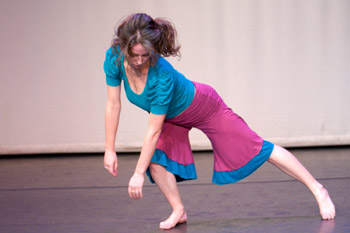
Solos reveal something stark about humanity if done well. Fortunately, Ruth Pethybridge and Thomas JM Wilson offer the right stuff in the subsequent two numbers. Love After Love begins with dramatic mugshots of Pethybridge against the back wall. Then the earnestness of graceful motion and honest music is suffused with vibrancy from her coloured cotton dress and Walcott’s uplifting poetry. The act quickens into a celebratory feast, like a dance interpretation of Amélie. However, irony steals into the culminating catharsis of “dancing with myself” – for all the lights turn on to reveal her adamantly dancing with us.
The minimalist piece Blotter begins with a long narrow stick, glided in spotlight by Wilson. But one scarcely recognises a man, who dons a full-body, figure-deforming suit in multicoloured stripes. The costume evokes a straitjacket – but you might fear yourself the patient, for Wilson makes you complicit: it is you who sees such hallucinatory colours on a head-covered creature. The atmospheric effect potently silences one inside. Lighting directs the audience – a horizontal light shifts up and down upon Wilson as though the rings of light around his body manacle his limbs. He oozes across stage to dreamlike piano.
Lastly, Anuradha Chaturvedi stamps and spins in rhythmic cycles in Tarana. She seems to vibrate with energy, and she conquers the constriction of space by vanquishing our awareness of setting. She displays technique and expression. It is a pleasure to juxtapose this raga with the other, contemporary styles: one finds commonality in the overt, smiling entertainment of the last piece and the sly self-conscious relationship of performer to viewer in the earlier ones.
One is sure to leave the theatre with private reflection after an evening of fun, dignified art.
Michele Chinitz, 15/01/09
Ballet In Small Spaces, Burton Taylor Studio, Wed 9 - Sat 12 January 2008
This week Oxford Playhouse’s Burton Taylor Studio is hosting a very unusual event: The Solos Project, curated by Susie Crow of Ballet in Small Spaces. An evening of six dance solos, ranging from flamenco to ballet, contemporary to butoh, this amount of movement has rarely (never?) been seen in the small studio space of the Burton Taylor. Yet, the dancers pull off every move beautifully, making the space seem expansive rather than restrictive, and providing us with a refreshingly diverse performance.
The night opened with a contemporary dance, Frantic Nymph, by Elly Crowther, filling in for another dancer at last minute. Drawing upon the movements of the Hawker Dragonfly as inspiration, Crowther flitted through the space, creating images that reappeared, but in different order or form. Especially dramatic were the times her dragonfly stopped along the wall – alert and active but nonetheless relatively calm.
Hecabe, choreographed and performed by Jane Connelly, utilised a mix of contemporary and flamenco dance styles, depicting the unhappiness of the Queen of Troy when captured by the Greeks. Slow, intermittent flamenco rhythms nicely juxtapose the sound of the ocean, and Connelly creatively makes use of a variety of costuming props – her shoes, a tie around her waist, her skirt.
The first half concludes with Le Chant de Pierres (the song of the stones) by Joelle Pappas, director of the Tac-au-Tac Dance Theater. The music, inspired by the sounds of hammers and chisels used by the sculptor Barbara Hepworth, is both expansive and percussive. Pappas effectively captures these elements in her work. She juxtaposed and interlaced short, quick movements with larger, freer movements, dancing with remarkable fluidity. Despite the constraints of space, while Pappas was dancing one felt that the theatre was also expansive – a true theatrical feat.
After a short interval, Adrienne Hart presented Clytie’s Poison, fusing classical and contemporary styles. Here, one benefited from being in a small venue, as each audience member was able to see the slight tilts of Hart’s head, the quick glances of her eyes, her character’s own uncertainty and discovery. Hart has a tremendous sense of balance and great flexibility, and makes effective use of different levels, from being on the floor to standing to jumping.
Baggage, performed by Ana Barbour, was perhaps the most fascinating solo of the night. Barbour presented butoh, a form of physical theatre art originating in post-war Japan. With a simple bag of, well, baggage, Barbour interacts with her load in different ways: carrying it, catching it, embracing it, being engulfed by it, and, eventually, leaving it. Barbour literally enters the bag carrying her load and moves within it, creating a moving, semi-human sculpture. Visually stunning with white costumes and white props against a black floor and background: this is a piece not to be missed.
The evening concluded with a ballet entitled Home is where the heart is, performed by Lisia Moala and choreographed by Susie Crow. Moala, a former principal dancer with Independent Ballet Wales, possesses stunning technique and a remarkable comfortableness in performance. The piece incorporates the unexpected in ballet and is dotted lightly with references to various major ballets. Again, despite the small venue, Moala is able to move freely throughout the space, and even insert powerful yet graceful leaps.
Special mention must be given to the costume and lighting designers. Celia Perkins has worked magic with a needle and thread, creating costumes that are simultaneously unique to each dancer, style of dance, and choreography, and yet create connections throughout the evening, helping to fuse the diverse solos into one performance. Scott Stewart’s lighting created the appropriate atmosphere, and undoubtedly contributed to the illusion of a large studio.
This production is on till Saturday at the Burton Taylor, and is one of the most exciting, diverse, interesting, and high-quality dance productions Oxford has seen. Buy your tickets now – and hope that The Solos Project will continue in years to come.
Ami V. Shah, 10/01/08
|
2009:
Ruth Pethybridge

Thomas Wilson

Hannah De Cancho
Photos: Mark Brome
2008:

Lisia Moalas

Ana Barbour

Joelle Pappas
Photos: Peter McCulloch
Fill in the boxes and then click "Send Review" to submit your review for The Solos Project.
|