





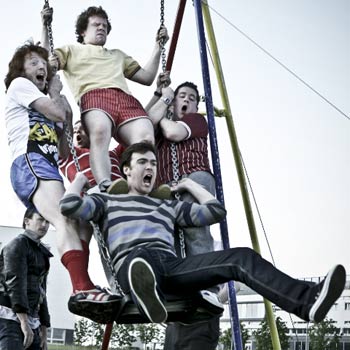
Florence Park is an apt setting for 'Decky does a Bronco'. While getting a bit lost trying to find the performance space I walked past more than one play area where children were playing on swings, before reaching the large round stage, where a swing frame stood as the centrepiece for 'Decky does a Bronco'. It turned out to be an incredibly versatile prop - the acrobatic actors clambered all over it ('don't try this at home' said the voice-over at the start!), hung off it and adddressed the audience from the top. The frame was also used as a doorway for the one indoor scene, and served as a visual symbol of the play's moods and themes.
The play's narrator is David (Martin McCormick), a self-professed 'pathological reminiscer', who guides us through a story from his childhood, when he and his four friends addictively met every afternoon at the set of swings on the hilltop near where they all lived, to attempt the ultimate challenge: the bronco. A bronco is when you stand on the swing and swing yourself higher and higher, until in one movement you kick the swing over the top of the frame and leap clear of the flying chains. The first demonstration of the phenomenon was done by four actors together, synchronised to a pulse of electronic music. This attached to it an importance which it retained throughout the play. The bronco was the last task in every obstacle race, the ultimate achievement in the eyes of the boy characters, and the point around which the story hinges.
Four actors play young boys, three more play the same boys grown up, and the narrator switches nimbly between his character's older and younger personae. The adult versions of the boys haunt the children's play, until half way through when the story becomes darker - they switch, and the child becomes the ghost behind the adult. The sinister streak apparent in the second half is there from the start in the play's undertone, because it becomes evident very early on that there is one child missing an adult version.
The play is short and they have wisely given it no interval. It carries you through to its conclusion without break or digression. The script (by Douglas Maxwell) has similar momentum. It is driven by waves of mood – the verbal and physical comedy of the young characters repeatedly undercut by a hint of some tragic element in one or other of the boys lives. The script sometimes gives way to minutes of unscripted physicality – the actors fully engage with the sheer energy of the boys they play, throwing themselves around the stage and on top of each other, climbing up the swing frame and falling off it, and hurtling towards the front row of the audience so you think they will not stop in time.
The feeling you are left with at the end is certainly a disquieting one, but the interactions, observations and worries of the young characters will also make you laugh - I particularly liked their conversation about why dock leaves always grow near nettles: yes, so that you can use them to stop the nettle sting, but how does the plant know?!
A really energetic play with a strong cast and acrobatics that consistently inspired applause but also drove the story forwards. Definitely recommended for an evening out this week.
The play's narrator is David (Martin McCormick), a self-professed 'pathological reminiscer', who guides us through a story from his childhood, when he and his four friends addictively met every afternoon at the set of swings on the hilltop near where they all lived, to attempt the ultimate challenge: the bronco. A bronco is when you stand on the swing and swing yourself higher and higher, until in one movement you kick the swing over the top of the frame and leap clear of the flying chains. The first demonstration of the phenomenon was done by four actors together, synchronised to a pulse of electronic music. This attached to it an importance which it retained throughout the play. The bronco was the last task in every obstacle race, the ultimate achievement in the eyes of the boy characters, and the point around which the story hinges.
Four actors play young boys, three more play the same boys grown up, and the narrator switches nimbly between his character's older and younger personae. The adult versions of the boys haunt the children's play, until half way through when the story becomes darker - they switch, and the child becomes the ghost behind the adult. The sinister streak apparent in the second half is there from the start in the play's undertone, because it becomes evident very early on that there is one child missing an adult version.
The play is short and they have wisely given it no interval. It carries you through to its conclusion without break or digression. The script (by Douglas Maxwell) has similar momentum. It is driven by waves of mood – the verbal and physical comedy of the young characters repeatedly undercut by a hint of some tragic element in one or other of the boys lives. The script sometimes gives way to minutes of unscripted physicality – the actors fully engage with the sheer energy of the boys they play, throwing themselves around the stage and on top of each other, climbing up the swing frame and falling off it, and hurtling towards the front row of the audience so you think they will not stop in time.
The feeling you are left with at the end is certainly a disquieting one, but the interactions, observations and worries of the young characters will also make you laugh - I particularly liked their conversation about why dock leaves always grow near nettles: yes, so that you can use them to stop the nettle sting, but how does the plant know?!
A really energetic play with a strong cast and acrobatics that consistently inspired applause but also drove the story forwards. Definitely recommended for an evening out this week.