Originally written and posted by Jamie Huddlestone (April 2010)
A Brief Introduction
If you've ever heard the clash of sticks, the jingle of bells and the squeeze of squeezeboxes after the choristers have finished on May Morning, you'll undoubtedly have encountered morris dancing; what you may not have encountered is the enormous variety of morris sides and traditions to be seen around Oxfordshire throughout the year. This guide aims to provide the uninitiated with a brief description of the different dances and their dancers, and hopes to explain in part why, in all probability, someone you know will find morris utterly compelling.
How Old is Morris Dancing?
Nobody's exactly sure - and there are more than enough stories of pre-Christian ritual heritage to bridge the uncertainty - but most reckon that English morris dancing is a development of the morisco, or 'Moorish [dance]', that swept through Europe at about the time the Moors were driven from Spain. A few of the dances that derived from the morisco, as well as those that may have inspired it, still persist in the folk traditions of Europe and northern Africa. Here are some examples!
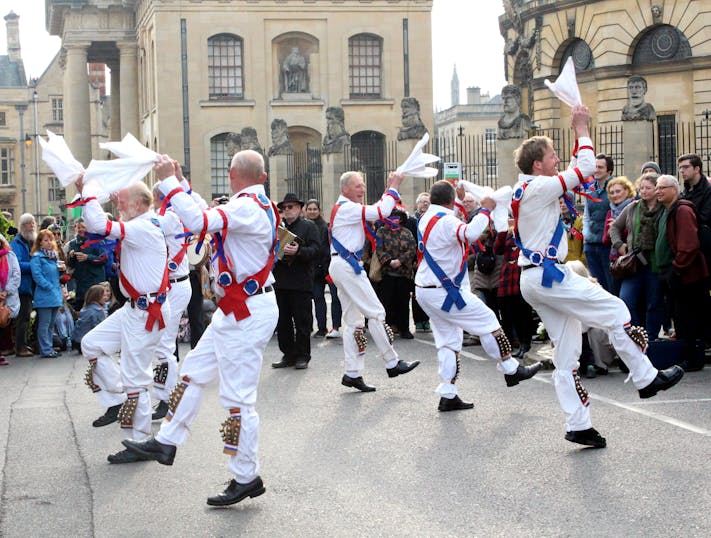
Morris dancing in Oxford courtesy of Cry Havoc.
Beltane Border Morris in Teignmouth, Devon.
Paloteao dance from the province of Aragon, Spain.
Moreska dance from the island of Korcula, Croatia.
Calus dance from Romania.
Tuareg sword dance from Saharan Africa.
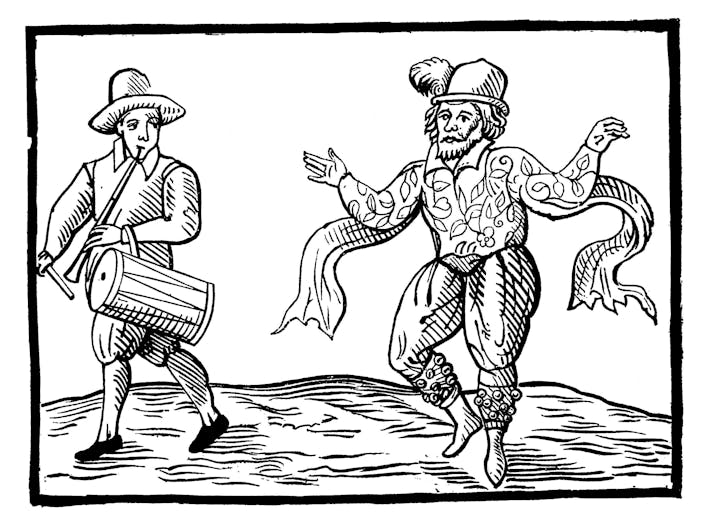
Elizabethan actor Will Kempe morris dancing from London to Norwich in the year 1600.
Certainly by Shakespeare's time, morris dancing was an established form in southern England. Enjoying a healthy exposure throughout society for a time, it fell into a slow decline in popularity but its form was kept fairly well intact by rural communities until the Industrial Revolution, when systematisation of labour and urbanisation jeopardised the character of agricultural village life and the festive traditions attached to its seasonal calendar. However, the morris in Oxfordshire continued to be performed in a few towns, most notably Headington, Eynsham, Bampton and Abingdon.
It was in 1899 that academic musician Cecil Sharp first encountered the recently-restored Headington Quarry Morris Men and subsequently embarked upon a life's work of collecting the traditional tunes of the English people; social worker and suffragette Mary Neal collaborated with Sharp to collect the dances, which she then taught to the girls of her Esperance Club in London. Their performances, and the 1907 publication of The Morris Book, encouraged several attempts to collect and revive the abandoned village traditions - a process that was frustrated by the Great War, but which would more than regain its momentum in the wake of the American folk revival of the 1950s.
This second English folk revival saw a wider development of the regional styles and a huge increase in the number of sides: some resurrecting their unique village repertoire, including Adderbury, Ducklington and Kirtlington, but many more combining dances from several traditions. A third revival beginning in the 90s has seen yet another surge of interest amongst a new generation keen to connect with traditional dance, music and song with increasing enthusiasm, proficiency and innovation.
What Kinds of Morris Dance Exist Today?
Nowadays several styles of morris dancing may be found throughout England, of which the following constitute by far the greatest share:
Cotswold: a flowing figurative style using both sticks and handkerchiefs that dominated the first revival and that persists as the popular perception of morris dance, originally found throughout Oxfordshire and Gloucestershire.
Border: collected from the towns of the Severn Valley and the English/Welsh border, an earthier, more aggressive stick-dancing style that was reinvented in the 70s.
North West: a more processional style found chiefly throughout Lancashire and Cheshire, which may include the wearing of clogs and the use of garlanded hoops.
Rapper/Longsword: from the North East and Yorkshire, intricate dances that involve tightly-woven figures using flexible two-handled / rigid one-handled swords respectively.
Molly: an eclectic revived tradition from East Anglia that is gaining popularity throughout the Midlands.
Understandably, the Cotswold traditions are the most widely practised amongst the morris sides of Oxfordshire, but most of the others are represented: for details, see the list of clubs below.
What does morris dancing involve?
Bells: Almost all morris sides wear bells; this could be just one or two tied to each clog, or a whole bell pad with over a dozen on each leg.
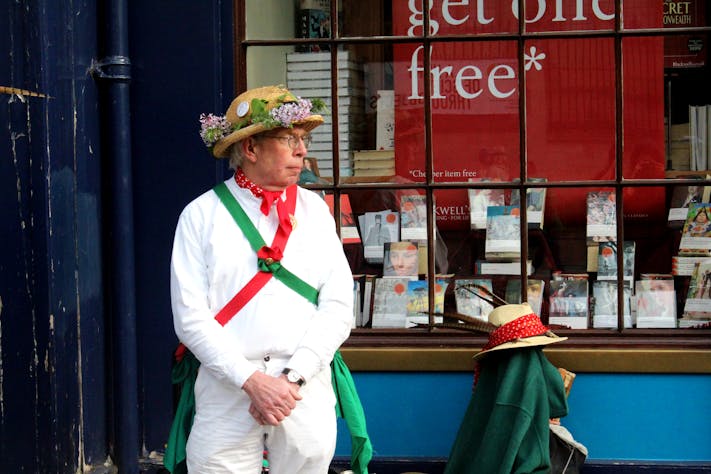
Hats: Most men's and mixed sides will wear hats; this is usually a top hat, a straw hat or a cricket cap. Those with brims are normally bedecked with ribbons and flowers; a Border dancer's top hat is also likely to be surrounded by pheasant feathers.
Baldric: The sash that many Cotswold sides will wear, often worn as a crossed pair; each side will use particular colours. Other sides will wear waistcoats, tabards, rosettes, or jackets covered with 'tatters' (particularly true of Border and Molly sides, who between them will wear just about anything).
Clogs: Typical to North West styles, these are today less like the ones you'd find in a Dutch souvenir shop and much more like sturdy shoes with thick wooden soles.
Sticks: Normally around three feet in length, hazel is generally considered the best wood to use. There are plenty of stick dances to be found throughout the traditions of southern England; Border is particularly noted for its aggressive (and occasionally quite suggestive) sticking.
Handkerchiefs: An integral part of the Cotswold style, hankies are tied/looped around the fingers and snapped upwards, downwards, outwards or around, depending exactly on where the dance is from.
Melodeon: The most popular musical instrument in morris, it's a small accordion that works in a very similar way to a harmonica, normally with two rows of buttons on which to play the melody and four pairs of buttons with which to provide a bass/chord accompaniment. However, all sort of instruments may be used: traditionalists prefer a simple pipe and tabor drum, whilst North West sides tend to include brass instruments; a solo fiddle is frequently seen with Rapper sides, whereas many Border sides like lots of percussion.
Fool: A distinctive character role retained by a number of sides, the Fool acts as the interactive link between the dancers and their public. In addition to making announcements, amusing children and playfully intimidating grown-ups for their hard-earned cash (traditionally by bashing them over the head with an inflated pig's bladder), they will skilfully interject in the dances with an improvised step or two, often perilously close to interfering with the movement of the other dancers. It's for this reason that the Fool is normally the best dancer in the side.
Beast/Hobby: Often a horse, but frequently any sort of creature, they too will interact with the audience and provide a comic contrast to the often quite serious-looking men in white!
Want to see some example dances?
Bampton, who claim an unbroken history of Cotswold morris dance spanning centuries.
The Shropshire Bedlams, the side that kick-started Border morris in the 1970s.
Horwich Morris Men dancing in the North West style.
The Newcastle Kingsmen, who revived the fortunes of Rapper dancing.
The Seven Champions, one of the most popular Molly sides, back for 2010.
That looks fun! How do I join?
The best thing to do is to go and watch the side you're interested in joining, then ask the side's bagman about membership over a pint in the pub afterwards! The bagman is the administrative force behind most sides; if you're not sure who that is, see who's looking after the sticks and/or other kit (this is also often the bagman's role). If you seem like a likely candidate, you may be directed to the foreman, who is usually responsible for training the dancers; or perhaps the squire, the nominal leader and senior dancer. These roles are often combined - it all depends on the side in question. If you can't go and watch your side of choice dance out, though, most will be happy to take enquiries by phone or email.
Be aware that many morris sides do have quite particular restrictions on eligibility for membership: many sides are single-sex, and some stipulate that you must be local to their traditional territory. It will cause no offence to ask what a side's requirements are, but it is generally considered bad form to challenge the answer you're given; do not despair, however, if you don't get the answer you were hoping for, as there will be plenty of other morris sides to suit your sex, locality or dancing ability not too far away.
List of Oxfordshire Morris Sides
Apologies in advance to anyone not on the list - if you want to be added, please email
[email protected] with details of your side!
Abingdon Traditional Morris Dancers
Cotswold (male)
http://www.abingdonmorris.org.uk/
Adderbury Morris Men
Cotswold (male)
http://www.adderburymorris.org.uk/
Adderbury Village Morris Men
Cotswold (male)
http://www.facebook.com/pages/Adderbury-Village-Morris-Men/328737817230
The Ancient Men (Oxford University Morris Men)
Cotswold (male)
http://www.am39.com/
Bampton Traditional Morris Men (Shergold's)
Cotswold (male)
http://www.bamptonmorris.co.uk/
Bloxham Morris
Cotswold (female)
http://www.kickback.btinternet.co.uk/Bloxham.Morris/Bloxham.html
Charlbury Morris
Cotswold (male)
http://www.charlburymorris.org/
Cornucopia
Step Clog (mixed)
http://www.cornucopia-dance.org.uk/
Cry Havoc
Cotswold (mixed)
http://www.cryhavoc.org.uk
Ducklington Morris
Cotswold (mixed)
http://www.ducklingtonmorris.org.uk/
Eynsham Morris
Cotswold (male)
http://www.eynshammorris.org.uk/
Headington Quarry Morris Dancers
Cotswold / Rapper (male)
http://sites.google.com/site/headingtonquarrymorrisdancers/
Icknield Way Morris Men
Cotswold (male)
http://www.icknieldwaymorrismen.org.uk/
Jabberwocky Morris
North West Clog (mixed)
http://www.communigate.co.uk/oxford/jabberwocky/
KBO Morris
Border (mixed)
http://www.kbomorris.co.uk/
Kirtlington Morris
Cotswold (male)
http://www.kirtlington-morris.org.uk/
Lumbawakk
Rapper / Border (mixed)
http://www.st-birinus.oxon.sch.uk/lumbawakk/
Mabel Gubbins Rapper
Rapper (female)
http://www.mabelgubbins.co.uk/
Masons Apron
North West Clog (female)
http://www.masonsapron.org.uk/
Mr Hemmings Traditional Abingdon Morris Dancers
Cotswold (male)
http://mrhemmings.org.uk/
Mr Leslie's Banbury Sword Dancers
Rapper (male)
http://www.adderburymorris.org.uk/Mr.Leslies/Banbury.Rapper.html
Old Speckled Hen
North West Clog (mixed)
https://oldspeckledhen.org/
Oxford City Morris Men
Cotswold (male)
http://www.ocmm.org.uk/
Queen Emma's Morris
Cotswold (female)
http://www.wospweb.com/site/queen-emmas-morris/index.htm
Ridgeway Step Clog
Step Clog (female)
[email protected]
Towersey Morris
Cotswold (male)
http://www.towerseymorrismen.org.uk/
Traditional Bampton Morris Dancers (Woodley's)
Cotswold (male)
http://tbmd.org/
Wolvercote Morris
Cotswold (mixed)
http://www.wolvercote.org/Morris/Wolvercote%20Morris.htm
Other Useful Links
The Morris Ring - founded 1934, the first nationwide association for Morris.
The Morris Federation - the UK's largest association of Morris and traditional dance teams.
Open Morris - encouraging mixed gender sides.
Oxfordshire Folk Association - an umbrella body co-ordinating folk dance in Oxfordshire.
Oxfordshire Morris - a living tradition: online version of an exhibition held last year.
Google map showing the location of Oxfordshire morris sides, both current and defunct (thanks to Taissa Csaky for this utterly amazing resource!)
SideFinder - a postcode search for your nearest side!
Cecil Sharp's The Morris Book (1907) in HTML.