





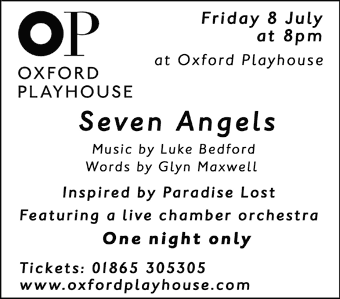

Glyn Maxwell has written exquisitely about his project in The Guardian. I wish I’d read his article before I went. Though an opera, this once-off Oxford Playhouse production about apocalypse, climate change, consumption and extraction could conceivably have expressed its meanings less opaquely. Now I see, and am retrospectively moved by, the poignant reflections on Miltonian ecology delivered by this tale of seven dispossessed fallen angels – humans – two of whom decide to remain on the despoiled planet, choosing (in the end times in which stars fall upwards) to do something, rather than plummet onwards helplessly. This is the Glyn Maxwell plea extrapolated from the famous last lines “They hand in hand with wand’ring steps and slow,/ Through Eden took their solitary way.”
I was unfeasibly disgruntled with Seven Angels in its first half, almost to the point of wanting to leave. I ranted bitterly to a stranger in the interval about not understanding a darn thing, the need for ‘accessible theatre’, and not being able to recognise Paradise Lost at all (although I am ashamed to have to add that it was not a text I even managed to read cover to cover for my English Lit BA, finding myself paralysed by its simultaneously theological and pornographic language). I was annoyed at the angels’ star-spangled pyjama costumes, I wasn’t following some of the abstracted repetitive cosmic scenes, and the emphasis on human greed in the ‘palace’ of Western civilisation disagreed with my climate politics, which sees the structural and the systemic (capitalism) as the cause of ecocidal human behaviour, not vice versa.
In the second half I forgave all. The tear-jerking music, the simple paper-cut-out sets of Edens, one welcoming and one desolate, the absence of conventional “environmental” themes and of Eve (our collective Eve is so far from being redeemed in the eyes of “God”), the invocations of unelected business-driven neoliberal conferences, and the insatiable prince’s (young Milton’s?) hunger for consumable books, reminded me of Carolyn Merchant’s assertion: “Today’s incarnations of Eden are the suburb, the mall, the clone, and the World Wide Web.”
According to his article, Maxwell went with the ingenious composer Luke Bedford to Wakehurst Palace’s Kew Gardens before anything else to research the latest prognoses for biodiversity in our burning world. Once there, it was thinking about the 2008 G8 summit in Japan and its sumptuous protester-free banquet which inspired a key Seven Angels scene, the last scene on Earth, served to a committee. The opera singers in the final staging, however, vindicate a kind of ecology-without-nature which has far more to say about the political imperative to open the global commons again (and do away with the palace) than about parts-per-million or green things that middle class Britons can do.
On that note, a gentle provocation, in conclusion to this review, which has become too long and too issues-oriented, but means to be very favourable to the technical virtuosity and artistic intention of those involved. Local representatives of Friends of the Earth were in the foyer, decorating a tree with patrons’ environmental pledges - they were there to support the opera, they said, because it “was about the environment”. In a climate of sweeping national cuts to the arts, it’s tricky to be selective about financial support, but FoE’s presence made it confusing to see the Royal Opera House, currently advertising BP with its “Summer Screens” events, credited as “co-producers”. If as Maxwell loftily proclaims, “Helpfully to stand or helplessly to fall is a choice made every day,” then distancing one’s art from climate-trashing corporations might be a step towards quitting the Devil’s party.
I was unfeasibly disgruntled with Seven Angels in its first half, almost to the point of wanting to leave. I ranted bitterly to a stranger in the interval about not understanding a darn thing, the need for ‘accessible theatre’, and not being able to recognise Paradise Lost at all (although I am ashamed to have to add that it was not a text I even managed to read cover to cover for my English Lit BA, finding myself paralysed by its simultaneously theological and pornographic language). I was annoyed at the angels’ star-spangled pyjama costumes, I wasn’t following some of the abstracted repetitive cosmic scenes, and the emphasis on human greed in the ‘palace’ of Western civilisation disagreed with my climate politics, which sees the structural and the systemic (capitalism) as the cause of ecocidal human behaviour, not vice versa.
In the second half I forgave all. The tear-jerking music, the simple paper-cut-out sets of Edens, one welcoming and one desolate, the absence of conventional “environmental” themes and of Eve (our collective Eve is so far from being redeemed in the eyes of “God”), the invocations of unelected business-driven neoliberal conferences, and the insatiable prince’s (young Milton’s?) hunger for consumable books, reminded me of Carolyn Merchant’s assertion: “Today’s incarnations of Eden are the suburb, the mall, the clone, and the World Wide Web.”
According to his article, Maxwell went with the ingenious composer Luke Bedford to Wakehurst Palace’s Kew Gardens before anything else to research the latest prognoses for biodiversity in our burning world. Once there, it was thinking about the 2008 G8 summit in Japan and its sumptuous protester-free banquet which inspired a key Seven Angels scene, the last scene on Earth, served to a committee. The opera singers in the final staging, however, vindicate a kind of ecology-without-nature which has far more to say about the political imperative to open the global commons again (and do away with the palace) than about parts-per-million or green things that middle class Britons can do.
On that note, a gentle provocation, in conclusion to this review, which has become too long and too issues-oriented, but means to be very favourable to the technical virtuosity and artistic intention of those involved. Local representatives of Friends of the Earth were in the foyer, decorating a tree with patrons’ environmental pledges - they were there to support the opera, they said, because it “was about the environment”. In a climate of sweeping national cuts to the arts, it’s tricky to be selective about financial support, but FoE’s presence made it confusing to see the Royal Opera House, currently advertising BP with its “Summer Screens” events, credited as “co-producers”. If as Maxwell loftily proclaims, “Helpfully to stand or helplessly to fall is a choice made every day,” then distancing one’s art from climate-trashing corporations might be a step towards quitting the Devil’s party.