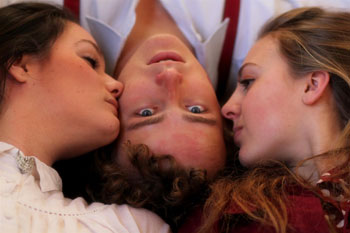
I meet Milja Fenger - Oxford student, screenwriter, playwright and director – to discuss her latest work Mephisto which runs at the Oxford Playhouse 22nd-25th February. The play, directed by Fenger, is adapted from Klaus Mann's 1936 novel of the same name and is a story of forbidden love, Faustian pacts and the rise of fascism in the Weimar Republic. The protagonist, Hendrik Höfgen is a German actor who flees his native country as the Nazis rise to power, fearing condemnation because of his communist past. On being pardoned by Nazi officials he returns to Berlin and continues his wonderful career, becoming closer and closer to the Nazi party and rejecting his previous values and even his lover, a Black woman named Juliette. He is given the part of Mephisto in Goethe's Faust: Part One, and starts to realise the true cost of his success; like Mephisto, he has made a pact with evil – one that will be very difficult to undo.
I ask Fenger why she chose this play. On a personal and practical level she answers, “I felt it was time for me to go for something very big and scary”. And that it is; there is a cast of 16 actors and a huge production team, not to mention the hundreds of seats in Oxford's largest auditorium. But the play is also thematically intense, dealing with issues of political, sociological and philosophical interest. It asks, she tells me, important questions such as; does it mean anything for the individual to be remembered in history? When does the individual become culpable for the actions of a regime? If resistance to evil is futile, should one still sacrifice one's life for the cause of the good?
She emphasises however that it will not be an overly serious piece of work; serious issues will of course be considered but one is likely to feel its effects only after having left the auditorium – such is the subtlety of the play's meditations. Indeed Fenger admits that she herself gets frustrated with theatre that is too heavy, too self-conscious, too serious. She tells me that good theatre must have certain joy to it, a “playfulness” as she puts it, and that one simply “can't do a serious play that is too heavy”.
Comic though it may be in parts, Mephisto is no escapist drama where one can reflect at a distance on how horrible a period that was in world history. Fenger is eager to stress that the themes of the play are very relevant to today's society and that the play as a whole can be seen as “an analogy for modern times”. Just as Hendrik is seduced by the appeal of comfort above anything else, so modern society has been drawn into over-consumption, becoming complacent about the environment and other species on the planet. Fenger tells me that nowadays “we tend to think 'I'm just 1 in 7 billion, what can I do? Nothing.' But even if this is true, we can still stand up...”. She admits that much of this thinking has developed since her time in Oxford, and that her degree in Human Sciences and time at the university is leading to her “mind being opened in a thousand directions”. She hopes that the audience of Mephisto will be able, after having seen the play, to make more informed decisions about the good course of action in any given situation – that the play will be subconsciously present in one's mind at the time of decision.
Dealing with real stories has become something of a theme in Fenger's work – though she attributes this to an unconscious attraction rather than a purposeful decision. Many of the plays and films she has worked on have even had autobiographical elements to them; Mephisto is arguably a roman à clef, an account of both Klaus Mann's life and that of the German actor Gustav Gründgens. The issue of cultural heritage and race relations is also a theme Fenger has repeatedly returned to in much of her work as a writer and director, from the forbidden love of different races in plays like Mephisto and Statements (Burton Taylor, 2011) to the meditation on the connection between national identity and race in the film The Road Home (2011). Although Fenger cannot say that this is something she has experienced herself, she has been unfortunate enough to “not be allowed to love someone” which is perhaps one of the things which drew her to these scripts.
This realism is reflected in the training and techniques that Fenger uses in her rehearsals with her cast. She is a fan of the understated, telling me that she feels “bored and cheated” by theatre in which actors state their emotions too loudly and too obviously. As an audience member she “loves to see that actors do not know what they're doing” although unlike her other works this play will not be improvised, Fenger encourages her actors to experiment with their delivery. Every monologue must be delivered differently each time by the actors, and in this sense no two audiences will see exactly the same production of Mephisto. Fenger speaks animatedly about her cast, especially the lead actor, Nick Howard-Brown who is said to have “stars in his eyes” as he acts, with “every single muscle in his body alive when he's onstage”.
I ask Fenger what her long-term plans are; “If I could be a scientist, a director and a writer....that would be great”. I realise that it's perhaps at least in part this unusual combination of interests in the sciences and the arts that gives Fenger her very unique edge. For now, she is working on an adaptation of an autobiography (as yet undisclosed) for film. Apart from that she regrets that she's made a promise to herself not to direct any more plays until the end of her degree next June. This is even more reason to catch this production while we still can. And I suspect Mephisto will be quite a special one.