






I went to look round a semi-ruined nunnery that was for sale once, and was impressed how many different weird damp smells there could be in one building. What that nunnery did for smells, Circle Mirror Transformation does for awkward silences.
It’s a tight five person drama, an intricate and layered piece of meta-theatre. A group of misfits meet in a community drama class, get on, play theatre games, fall out, and perhaps get to know themselves better. The games circle round – we see the same counting trust exercise, the same group telling stories as each other, the same re-enactments game, and each time we learn a little more about the characters.
The spread of ages and life experience make this an exacting show, and it was handled brilliantly by the tight cast and crew of Boulevard Productions. At times there are more layers than a Danish pastry, as each actor reveals their own character by speaking as another character, but this was handled so well that even when (sitting in the round) I was behind someone speaking, I could tell their expression by that of their listener.
Hope Healy gave Marty the teacher a bright, fragile optimism. She was determined (DETERMINED!) to put a brave face on everything, however unpalatable. And Alex Greene gave divorcé Schultz a sweet, naïve inarticulacy and romanticism. Google tells me helpfully this role was played by Toby Jones in the
James (Andrew Spielmann) and Theresa (Alex Coupland) both defied their youth by inhabiting characters who have obviously and will continue to repeat their mistakes, having their heads turned, or falling for the wrong types. Alex is in her first year, and how she’s managed to get settled in on top of rehearsing this piece is mind bogglingly impressive. Evangeline LaFond had to portray a dorky teenager, and again, made the age gaps believable, the lack of agency over her own life, her silent fury.
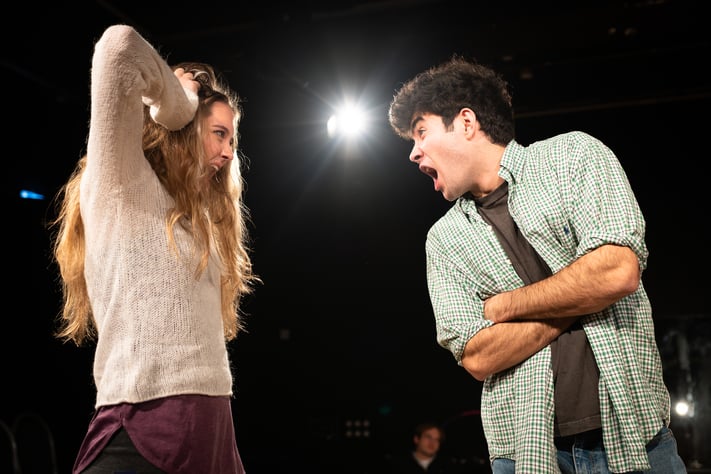
The costuming was on point. The lights conveyed crucial shifts. The incidental music was rich and yet unobtrusive. The set was minimal and just right. Less is more in this show, and it really works, especially in the dark confines of the Pilch Studio. Even in the dark, we could tell the cast’s moves were precisely choregraphed, and it takes deceptive skill to mess up counting, in perfect time.
This is no Disney story. If you want the truly redemptive power of theatre, go see Our Country’s Good. In this piece, flawed characters are not magically transformed into happy harmonious humans. Just as anyone gets good at an exercise, Marty somehow sabotages it, and in her most excruciating move gets everyone to write their darkest secrets, which are then read out loud. Yes, this is a dark piece and at times it is a wonder it’s so funny. But with crucial meaningful exchanges delivered through nonsense words, or while acting as a baseball glove, the absurdity of Annie Baker’s writing and the sharpness of Charlie Lewis’ directing made a perfect pair.