
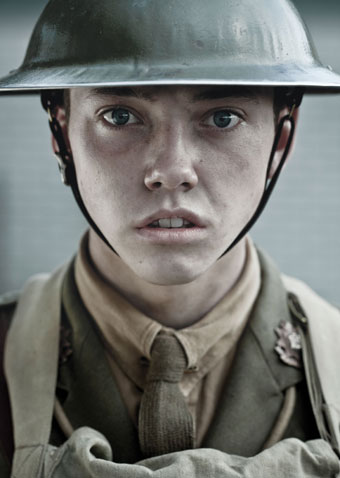
Journey's End is set in the rat-infested trenches just outside of St Quentin in March 1918. It is a compelling account of warfare, based upon R.C. Sherriff's own experience as a Captain in the East Surrey regiment, depicting war as meaningless and destructive. When in the trench you find yourself in limbo, talking about 'down' and 'up' the line as though they are factious places in one of Osborne's books. Without the gun blazes at the end of each scene, the erosion of No-Mans-Land as the German armies get closer and Trotter's game one would hardly expect that any time had past at all.
The audience is inducted into the Officers' dugout along with the enthusiastic newcomer Raleigh, and instantly becomes a part of the bustle. Raleigh, performed by Quintin Fraser, quickly looses his schoolboy keenness and adopts a mature weariness. Fraser conveys this transition well, branding his character with the respect of a hero. Juxtaposed is with him Hibbert, the most reluctant of men, also known as the 'worm'. Played by Roland Lloyd-Parry, Hibbert is introduced as the most reprehensible of characters, someone who betrays his fellow officers by wishing to be sent 'down the line'. An Officer must be able to hold romantic notions, be brave and able to push forward against all odds.
Stanhope - the handsome and courageous hero, respected by his fellow officers and men - is played admirably by Richard Godwin. Responsibility has made him tired and disillusioned with the war: he depends on whisky to forget anything but the present. Raleigh, his girlfriend's brother, upsets this balance between consciousness and oblivion. Stanhope's nature therefore varies between one of a mature, responsible leader and that of a schoolboy subjected to the war, making the best of the bad orders of a dithering Colonel. Osborne (Andrew Humpreys) acts as his close friend throughout these mood swings as one assumes he had a thousand times before, attaining the esteem of all the other characters who refer to him lightly as 'Uncle'. The characters of the corpulent, rather down to earth Trotter (Martin Hemmings) and inoffensive batboy Mason (Des Fitzgerald) introduce some light comic relief into the play. Trotter seems almost unaffected by the war, concentrating upon his daily routine of eating, standing on duty and writing letters home to his wife. The innocent Mason in the meantime endeavours against all the odds to prepare liveable quarters for the Officers, complete with imaginative cooking.
The dugout itself is a realistic construction that succeeds in fusing all of the characters together, making the most of the props used and yet remaining subtle and simplistic. Anyone who sees this play will be convinced by the battle that blazes through the dugout door, and the lingering odours of smoke and, on occasion, bacon draw the audience in even more. The use of faint amber lighting, candles, and faint traces of radiating sunshine give a confused sense of time and strengthen the appeal of the disillusioned characters.
The audience leaves the play not with nationalistic pride but with a weary uneasiness about war. This is a mature representation of trench warfare free from over dramatisation and a credit to the actors and crew involved. Captivating the audience, naturally intermingling with their surroundings and unconscientiously conversing about their lives the characters are unsurprisingly engaging. Those who are acquainted with Rowan Atkinson's Blackadder Goes Forth will be able to see why the play was parodied. I would encourage anyone to see Journey's End this week.
Victoria Marshall, 5/6/2001