




Viennese New Year Concert

Traditional Viennese concert with programme including Grieg’s piano concerto, works by Lehar and Suppe, as well as all your Strauss favourites.
Photo credit: Rob van Dam Photography
Sheldonian Theatre, Broad Street, Oxford OX1 3AZ, Sat 18 January 2020

The "mercurially brilliant" pianist Tom Poster will give his highly acclaimed performance of Grieg's evergreen Piano Concerto before exuberant conductor, Steve Bell whirls the orchestra through a sparkling programme of Strauss favourites and other Viennese delights. Banish those January blues with this marvellous music!


January 20, 2020
Truth descends upon the concert pianist

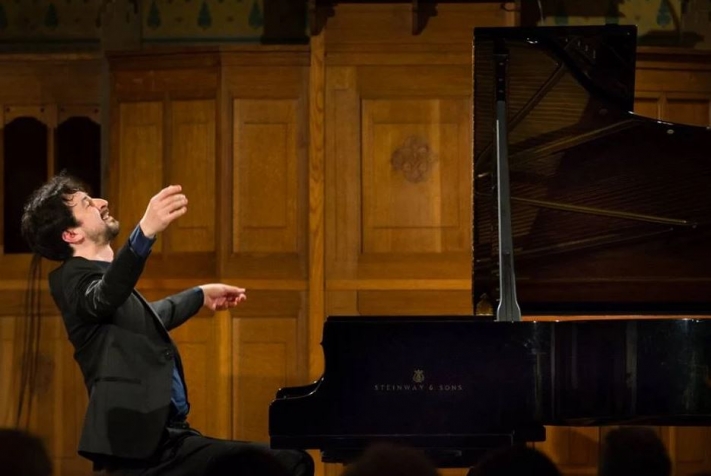
We opened the 47th Viennese New Year concert from City of Oxford Orchestra with Mozart's overture to The Marriage of Figaro, not wholly felicitously since this was a rather thumping rendering, the timpani/strings balance slightly askew. When Tom Poster, the Grieg soloist, appeared, he was straight into the Concerto's famous rhetorical flourish, establishing the A minor tonality, then on into a capricious passage perhaps resembling an elves' dance. Tom was very animated on his stool, arching his body this way and that, sometimes leaning expansively back in apparent contemplation of the 32 panels of Robert Streater's Truth Descending upon the Arts and Sciences - surely not a bad medium of enlightenment for a concert pianist! My neighbours Hsiao-Han and Ing-Wen, tourists from Taiwan, were delighted by the visual aspect of Tom's performance as well as by his virtuosity.

For the extended cadenza, musically the finest element of the movement, he let loose a descending cascade of octaves followed by a massive treatment of the same theme, and thunderous rumbles with the left hand. He then produced bell-like accents in the lyrical adagio, and in the finale, the rapid succession of folk dance sections swept past us as soloist and trumpets hammered out the triumphal coda. This was another demonstration of the combination of power and delicacy that's the hallmark of this pianist; one of the two finest to play regularly in Oxford, in my view. The audience rapture was rewarded by the encore of a Nocturne by Clara Schumann – Opus 6, No.2, I think.

Attendance at last year's concert was a trifle on the sparse side, whereas the place on this frosty night was hearteningly full this time – was it the presence of Tom Poster that brought out the crowd? Tom was a pupil at Cherwell School in the nineties and has a long-standing musical connection with the city. Is it fanciful to wonder whether these circumstances may just possibly add a certain je ne sais quoi to his playing in Oxford?

After the interval we got down to the New Year motif. Suppe's rather stirring Morning, Noon and Night in Vienna was adorned by Peter Adams' cello solo, and hereabouts ebullient conductor Stephen Bell began to treat us to little snippets of introductions, acting as pedagogue and cheerleader. The dance pieces began with Lehar's lilting Gold and Silver Waltzes, followed by the choppy rhythms of the Overture to Die Fledermaus. The Feurfest [fireproof] Polka, prosaically a commission to market the production of a fireproof safe for a famous Vienna safe company, so closely resembled the Radetzky March that it was only the presence of an 'anvil', whacked with relish by percussionist Donal O'Neill, that persuaded me otherwise. He and timpanist Donna-Maria Landowski then tucked into the drama of the Thunder and Lightning Polka. We rounded things off with the inevitable pièce de résistance, the Blue Danube, employed among countless applications by Carol Reed in his 1956 circus film Trapeze, with Burt Lancaster curving graceful parabolas above a gasping audience until the fatal plunge.


January 21, 2019
A New Year box of delights

There has been a continuous tradition of concerts on New Year's Day in Vienna from 1838, becoming predominantly Strauss family affairs in 1939 and assuming a standard character of the best-known pieces by that prolific brood. The City of Oxford Orchestra is, by comparison, a New Year novice, having inaugurated its series in 1974.

The programme notes point out that Mozart's overture to The Marriage of Figaro contains not a single melody that later features in the main body of the opera – an indication perhaps of the composer's fecundity of invention – whereas Strauss II's overture to his Die Fledermaus is a more conventional compendium of tunes that pop up later.

In Mozart's aria Die Bildnis from The Magic Flute, tenor Joshua Ellicott instantly demonstrated that he had volume to spare. It was a pity, therefore, that even his voice was overshadowed to the extent of occasional inaudibility by the 33-strong orchestra both in Zeller's Roses in Tirol and in Sieczynski's Vienna, City of My Dreams, the horn and trombone combination being a particular offender. Gratifying though it was in principle to note the presence of four horns and three trombones, as it turned out one instrument fewer in each case might have helped the balance of sound.

The Mozart was succeeded by a couple of Lehar operetta arias, the delightful and lyrical My Little Nest of Heavenly Blue and the famous You Are My Heart's Delight. I was at school with one of Franz Lehar's grandsons and I can remember his playing a keyboard version of this latter on an ancient honky-tonk piano that was missing several keys. Ellicott sang and took his applause all wreathed in smiles – his sense of enjoyment was infectious.

Franz von Suppé's Morning, Noon and Night in Vienna is a triptych whose Morning section begins with some drama – an already blazing sun coming up fast and fully formed over the horizon. The solo cello of Ben Hughes delivered plaintively the lilting melody of the Noon waltz. Then the voice of the Strauss son Eduard was heard in the form of his jigging Bahn Frei! [Track's Clear] polka, evocative of a steam engine.

In Part II the programme delved into the Strauss Waltz, Polka and March box of delights. Conductor Stephen Bell gave a pithy introduction to most of the pieces, producing little anecdotes. Conducting with verve, his enthusiasm ran to the bending of his knees and making little springs in the air, a springboard diver plunging into the Mariana Trench. These dance pieces were played with notably rhythmic grace with just a couple of infelicities: in the Emperor Waltz there was hesitation in continuity around the crescendo build-up, and I thought in the Pizzicato Polka the violins, striving for volume contrast, slightly overdid the sotto voce plucking. The Blue Danube Waltz, a favourite for circus high-wire acts, was delivered with swinging aplomb, sending us off happily into the night air.

Review this

Share this page

© Daily Information 2026. Printed from https://www.dailyinfo.co.uk/feature/14591/viennese-new-year-concert

Top