





Let’s get one thing clear – this is not a straight-up stage adaptation of the sci-fi classic, H.G. Wells’ quaintly localised novel that saw Martians ransacking Woking and Leatherhead. Nor is there much trace of the Spielberg film version; no sign of Dakota Fanning, Tom Cruise, blood-red creepers or many-legged leviathans. This is a different beast entirely, one in which the only tripods seen are those used to hold up old-timey radio mikes.
The audience is greeted by the four cast members, all simultaneously playing the pipe-wielding Orson Welles, and reflecting on the wonder of the wireless, the inauspicious wooden box that could bring Roosevelt, Hitler or Chamberlain to life in your front room. Welles celebrates how he harnessed this extraordinary power in 1938, transplanting The War of the Worlds from Surrey to New Jersey and performing the piece as a radio programme. So effective was the execution, and so beguiling the broadcast’s layers of disguise, that some listeners believed that an invasion really was afoot. Welles’ piece of audio trickery had whipped up the Eastern seaboard into widespread hysteria.
We see the broadcast cleverly re-enacted onstage here. Announcers interrupt a live concert from a local ballroom to inform listeners of curious explosions detected on the planet Mars. Bulletins become increasingly tense, and intrepid reporter Carl Phillips goes to investigate the mysterious cylinders that have landed in the New Jersey countryside. Crucially, everything is heard and not seen, as Carl approaches a green glow coming from offstage. It is his reaction, and the reactions of curious onlookers, that convey the true horror of the discovery.
A sudden structural sucker-punch follows, as the play veers away from re-enactment and introduces a 21st-century strand to the story. We meet Mina, a young producer, who is desperate to make her own podcast but struggles for content. In a stroke of good fortune, she comes across a family for whom Welles’ Halloween hoax had profound and lasting implications. We learn that something happened on that panic-stricken night that tore the family apart. Mina’s boss smells blood and implores her, rather ominously, to “go for the jugular”, to bring him back “something with legs”, and Mina duly heads to Grover’s Mill, the site of the ‘landing’, to investigate further.
From this point onwards, the cast flit between the play’s different layers. Welles returns, musing on the impact of his broadcast, at once apologising for misleading the public and crowing about the efficacy of the ruse. The actors perform vignettes of terrified listeners running for trains and rednecks readying themselves for the coming war. In the modern storyline, Mina visits a UFO-themed diner and an alien-looking water tower, but also uncovers something more sinister beneath the small-town charm of a local family. While Dad watches the news and Mom flicks away on Candy Crush, their son, a reclusive media dropout, works away on the Internet. His secret is a dark and dangerous one, especially given that the setting is the lead-up to the 2016 Trump v Clinton presidential election. There are whispered snippets about lizard people and paedophiles, the Chinese and the Mexicans. The conspiracy theories are not limited to the US, either: one character ponders what really happened in that Parisian tunnel.
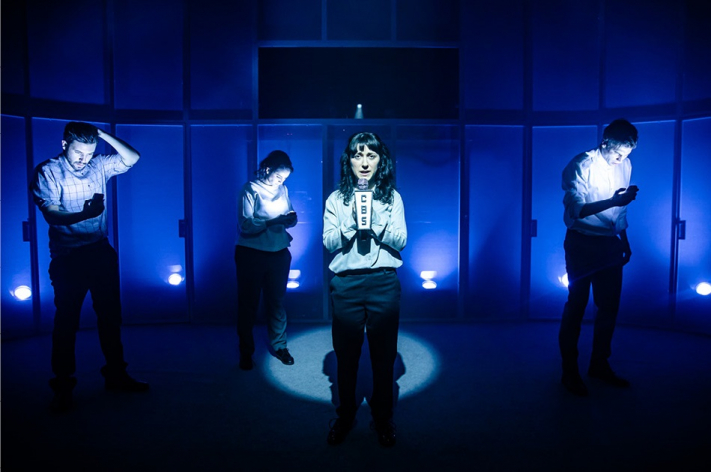
It all takes place on a stage designed to look like a radio booth, and in a clever touch, the show’s sound technician looks on from behind a Perspex screen as if part of the studio. Costumes are minimalist, allowing each actor to play a host of minor characters. While the cast make the most of the stage-space, bowling over pedestrians in a crowded street, or wrestling through a throng of terrified bystanders, this is a play about voices. The versatility of the cast in this sense is simply staggering: each member can switch with ease from Welles and his plummy radio announcers to a waiter’s drawl or a redneck’s southern twang. Rarely, if ever, do the accents slip.
As the play hurtles towards its jaw-dropping finale it metamorphoses again in terrifying fashion. Here, and throughout, it’s knotty narrative, one that demands rapt attention from the viewer. It asks a barrage of questions too, using Welles’ deception as a device to examine modern-day misinformation. Radio may have given way to TV and Twitter, to zeitgeists and viral news, but the same issues of veracity and authorial intent remain as problematic as ever, and the play’s ending highlights this indiscomfiting fashion. This War of the Worlds adaptation by Rhum + Clay is a haunting work of post-Covid theatre, a slippery, multi-layered piece that warns us not to swallow everything that comes from the tap. “Have you not learnt your lesson?” Orson Welles asks us, jabbing at us with his pipe. Worryingly, I don’t think we have. Not yet.