





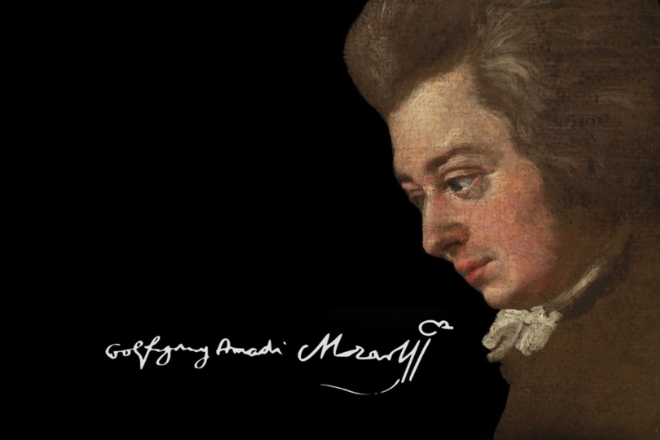
Mozart yawned, shivered, and reached for his brand-new notebook.
The morning of Monday 9th February 1784 was bright but freezing in Vienna. It was (and still is to this day) the coldest winter on record in Europe, with temperatures dipping below -20C, and the ice on the Danube was four feet thick. It had been like this since November. The Laki volcano that erupted in Iceland the previous year was the cause, but Mozart wasn’t to know that. In his and Constanze’s modest apartment in Judenplatz they had almost run out of wood to burn, and the ice on the river meant that boats carrying new stocks of fuel couldn’t reach the city.
Nevertheless, this was the morning that Mozart finished composing his 14th Piano Concerto. We know this because it was also the first time in his life that he had bought a notebook to record his compositions, and this concerto is on page one. He blew on his fingers. The keys on his fortepiano felt like slivers of ice, and the only way he could stop the ink in his quill from freezing was to add brandy to it. But in that bleak midwinter, Mozart conjured spring with this richest, lightest and most joyful of compositions.
241 years later the Holywell Music Room plays host to the same concerto, joined by its predecessors the 12th and 13th. The venue is ideal: completed just six years before Mozart was born, it sits, like him, on the boundary between baroque and classical. The musicians are illuminated by a couple of domestic standard lamps rather than the latest LED spotlights. And the acoustics are perfect. In this time capsule of cultured elegance, a string quartet from the English Chamber Orchestra, and soloist Cristian Sandrin, make a small, spellbound audience feel like those privileged Austrian music afficionados at Mozart’s first subscription concert.
You might think that three piano concertos in a row – nine movements in total – is stretching an audience’s endurance too far. But these pieces are so light, playful and nimble, and performed so effortlessly, you hardly notice you’re consuming them, like teaspoons of caviar on mini blinis. The 12th is the simplest of the bunch. Officially still part of Mozart’s juvenilia, it has a call-and-response relationship between strings and piano. They perform in turn, passing melodies back and forth like footballers showing off on a training pitch. In the second movement, the piano plays alone for so long that it almost feels like a sonata. And in the third movement, the two sections play off each other as if providing the punchline to a witty, and slightly risqué, joke. Close your eyes, and you can almost hear Mozart tittering at the innocent naughtiness of it all.
The 13th is more dramatic, with harsh swipes of the bow, and sweeping glissandos lifting the violinists briefly off their seats with excitement. The English Chamber Ensemble need only the briefest glances at each other to ensure they are in perfect synchronicity. And at the piano, Cristian Sandrin remains impassive and serene. That old line of the Archduke’s from Amadeus (‘Too many notes, Mozart’) comes to mind as the air is filled with harmonies bouncing off and dancing with each other. Sandrin’s control is immaculate. Even when playing only with his right hand, his left wafts above the keyboard, conducting and guiding its busier partner, and Mozart’s reply comes just as quickly to mind: ‘There are just as many notes as there should be, Your Majesty.’
And finally, the 14th.
Now recognised as the first work of Mozart’s mature period, it is the most technically complex of the three pieces in this programme. Mozart was especially proud of it. He wrote to his father, describing it as ‘one of a quite peculiar kind’ and declaring that ‘it will make you sweat’ (an enticing promise that February).
Starting unusually in 3/4 time, the concerto lilts rather than leaps into action, and its melodies are more complex and unrestrained than the earlier works. But the phrasing and articulacy of the string ensemble remain a seductive combination of precision and style. The final movement is a classic Round, with the string quartet sharing the tune like campers round a bonfire, and the piano flowing like a thawed Danube. It’s Amadeus at his most unfiltered.
Mozart put his quill back in its box. He was thirty years old, and five years from death. His family left Judenplatz later that year, and as they ran out of money they moved from place to place in Vienna. Nowadays there’s a department store where his last home used to be. But in the crisp air of Holywell Music Room, and beneath the expressive fingers of Cristian Sandrin, the winter of 1784 made us sweat again.