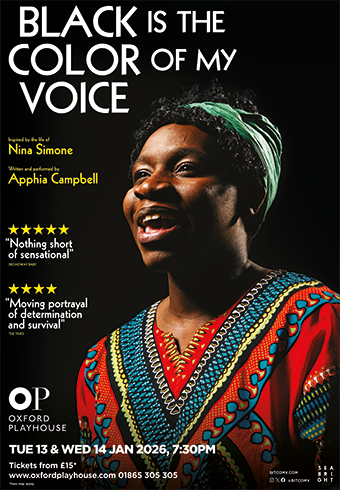






A truly powerful and thrilling performance, Black Is the Colour of My Voice unapologetically confronts racism, domestic violence, and the personal cost of resistance. Written and performed by Apphia Campbell, the play charts the life of Nina Simone, tracing how she armoured her voice and artistry to fight injustice during the civil rights movement.
The production leads the audience on an emotionally turbulent journey, punctuated with moments of sharp humour, making for a truly gripping experience. We first encounter Simone as a young, prodigious Black girl whose extraordinary musical talent prematurely exposes her to the brutal realities of racism—most painfully through her thwarted dream of becoming a classical concert pianist. This formative injustice becomes a defining wound, shaping both her artistry and her anger.
Campbell’s embodiment of Simone’s parents, performed as part of her solo tour de force, is imbued with a perfect blend of comedy and cultural and religious nuance. She captures the parental authority experienced by a Christian African-American child, while her use of personal objects cleverly communicates Simone’s deep love for her mother and father, even as it reveals the tensions created by their expectations and limitations.
As the narrative moves through Simone’s struggles with racism, sexism, and violence, Campbell powerfully illustrates how these experiences fuelled her evolution from classically trained pianist to revolutionary jazz singer. From the very first note, Campbell’s vocals are pure perfection — effortlessly commanding attention and emotion. Each phrase is delivered with breath-taking control and sincerity, woven seamlessly into a tapestry of brilliant musical numbers drawn from Simone’s legacy. The depth, clarity, and power of Campbell’s voice create an unforgettable experience, leaving the audience utterly captivated.
Crucially, Campbell allows Simone’s voice to be heard not only as a woman, but as a Black woman navigating a hostile world. Her performance is expressive across a sweeping range of emotions, communicating through voice, tone, and physical expression with such passion that the audience is consistently moved.
This is a performance that cannot be missed. It simultaneously entertains and educates, illuminating Nina Simone’s life while exposing the broader struggles of striving for artistic and personal freedom as a Black woman. Through sheer musical and theatrical brilliance, the production delivers powerful and painfully relevant messages about racial and gender inequality and violence. This performance is nothing short of remarkable—and Nina Simone’s legacy resonates long after the final note fades.