





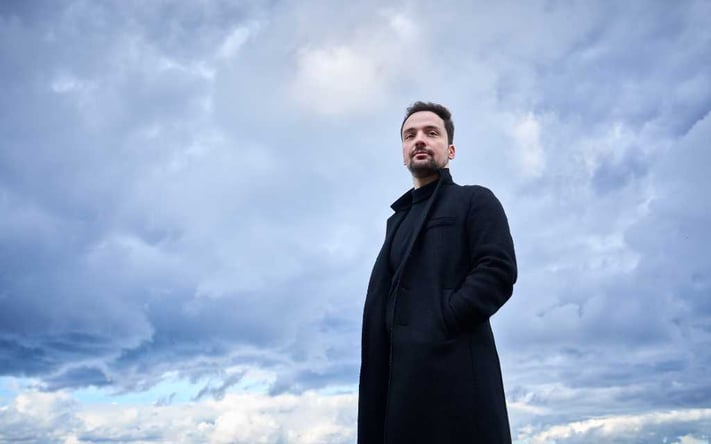
Cristian Sandrin’s recital, The Tempest, offered an absorbing and intelligently constructed journey through Mozart, Beethoven and Schubert, three composers whose piano sonatas chart the evolution of the Classical style into something far more searching and personal. Sandrin proved himself a thoughtful guide, combining technical assurance with a clear interpretative voice.
The Mozart sonata opened the programme with playing that was notable for its clarity and restraint. Sandrin resisted any temptation to over-project, instead favouring a clean, transparent texture and finely controlled articulation. Ornamentation was neatly integrated, never drawing attention to itself, and there was an appealing sense of ease in the phrasing. At times one might have wished for a greater sense of spontaneity or risk, but the overall impression was one of stylistic awareness and careful shaping.
Beethoven’s “Tempest” Sonata formed the emotional and structural centre of the recital, and here Sandrin’s playing took on a greater sense of urgency. The opening movement was handled with a strong feeling for its underlying tension, the shifts in mood clearly delineated without becoming exaggerated. Sandrin’s control of pacing was particularly effective, allowing the music’s more introspective passages to breathe while maintaining a clear sense of direction. The slow movement was understated and inward, avoiding sentimentality and instead drawing the listener into a more private sound world. In the finale, Sandrin found a compelling balance between drive and clarity, the perpetual motion articulated with precision and a growing intensity that never tipped into harshness.
The transition to Schubert felt entirely natural, and Sandrin’s approach to this repertoire was among the most convincing aspects of the recital. He demonstrated a strong affinity for Schubert’s long-breathed phrasing, allowing melodies to unfold with patience and a subtle sense of rubato. There was a welcome refusal to over-dramatise; instead, Sandrin focused on colour and harmonic shading, bringing out inner voices with sensitivity. The result was a performance that captured both the lyricism and the underlying fragility of the music.
Throughout the programme, Sandrin’s playing was marked by control and intelligence, with a clear sense of the relationships between the works. If occasionally one longed for a touch more boldness or abandon, particularly in Beethoven, this was balanced by the coherence of his overall conception.
The Tempest was, in the end, a reflective and finely judged recital, notable less for overt display than for its thoughtful musicianship and stylistic integrity.