





Henry Purcell, 1659 to 1695, was an English composer of the baroque era, considered one of the best English composers of all time. He was prolific, writing not only choral music, but also opera (most famously Dido and Aeneas), semi-operas, incidental music, theatre music and bawdy songs. However, not much is known about his life apart from the bare facts of his marriage, children and death. He was born into a musical family, was a chorister and then an organist; he experienced both the Great Plague and the Great Fire as a young boy and worked under the patronage of three monarchs. Four of his children died as babies; two survived. He probably died of tuberculosis.
From these scraps, as well as general information which can be gleaned about what was going on around Westminster at that time, Claire Norburn, writer and producer, has woven a musical play about his life and times, presented as part of Oxford Festival of the Arts. Much of his later work was written for plays but, as these plays are no longer produced, she set out, as she puts it, to place ‘some of his songs in a dramatic context’.
The stage set is very simple: Purcell’s crumpled bed on one side, the three musicians on the other, with screens at the back behind which the two sopranos come and go. Purcell is feverish, his mind jumping back and forth and so his story is told piecemeal, not chronologically, interspersed with his music. We hear about his childhood, growing up near the place where they took the plague bodies; we hear about his experience of the Great Fire – the choirboys being led by the Dean to fight the fire; we hear about him meeting his wife, their sadness at the deaths of their first four children; his interest in the theatre (and some of the actresses too, maybe). Yes, he wrote beautiful choral music, but he also wrote great theatrical music, some specifically highlighting the situation for women ('What Can We Poor Females Do?' for instance).
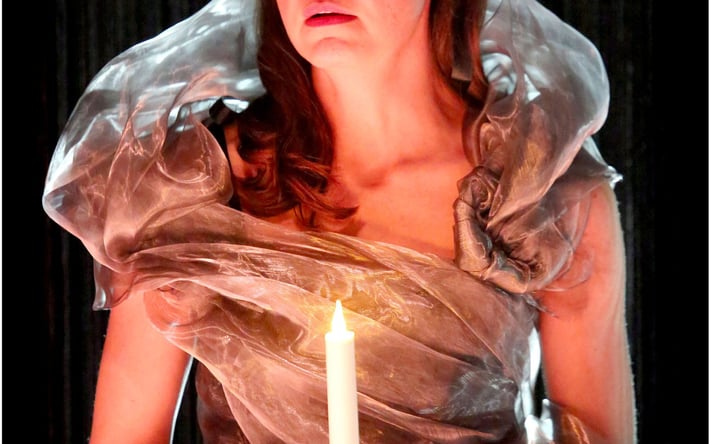
Niall Ashdown is thoroughly convincing as the easy-going Purcell, easily led maybe but dedicated to his music.The two sopranos are outstanding: Sarah Lambie (Frances Purcell and Jane) and Héloïse Bernard (Letitia Cross and Mrs. Gibbons) are described as actor-sopranos and they fulfil both these roles to perfection – sometimes funny as they squabble, sometimes very moving.The mood is often light and funny: Purcell addresses the audience, especially at the beginning (‘What are you all doing in my bedroom?’) and the two women fight (in song of course). Serious themes are part of the story too, though: the fire and the plague and the deaths of Purcell’s children. As the two sopranos sing 'O Dive Custos', an elegy written on the death of Queen Mary, Purcell picks up the shrouds of his four dead children – it is clear for whom he really wrote the elegy. At the end, as Purcell lies down to die, Frances starts singing 'When I am laid in Earth' unaccompanied. Sublime.
The three musicians are very important: Joanna Lawrence on the violin, Miriam Nohl on the cello and Oliver James Reuthen on the harpsichord. The music is faultless and beautifully played but the musicians join in some of the fun too, seemingly spreading gossip and enjoying awkward situations.
Purcell died in 1695 but his music lives on: Britten’s Young Person’s Guide to the Orchestra, the theme tune to Clockwork Orange, the dance scene in Pride and Prejudice (2005) and in many other places.
Claire Norburn has founded a charity called The Telling, ‘where music and theatre collide’ and has developed a new genre, concertplays as she calls them, fourteen to date, mostly working with Nicholas Renton who serves as this musical's director. Starting with the Empowered Women Trilogy in 2020, she has covered such personalities as Hildegard von Bingen and Dickens. Purcell is the latest production. It is funny, moving, a delight for both eyes and ears – an outstanding piece of theatre and highly recommended.