





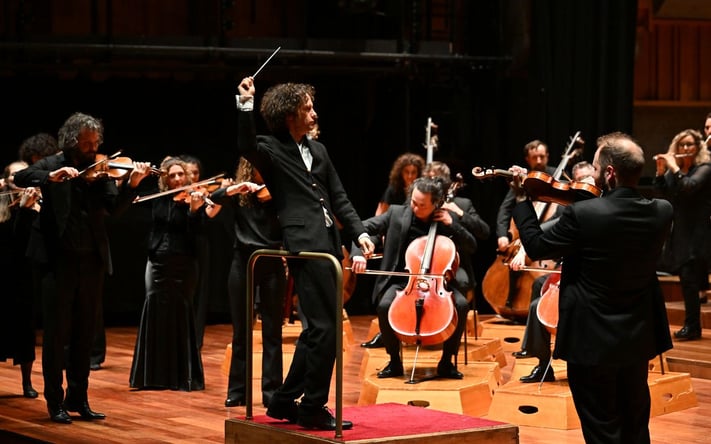
This was my first visit to the new Humanities building and it is easy to see why this is fast becoming a key part of our city's cultural life. It is a welcoming space and will be playing a central role in our musical and theatrical lives for decades to come. There are some kinks that need to be worked out – such as the ability to pre-order interval drinks – but overall it is a lovely place to visit.
The Sohmen Concert Hall is a splendid venue. Ample leg room, a warm acoustic that envelops the audience whilst also affording absolute clarity for the music to be heard at its best. I look forward to many future concerts.
The Aurora Orchestra have, over the past 2 decades, established themselves as one of our leading chamber ensembles. They are particularly known for performing works entirely from memory. And this concert focused on Mozart's final symphony – the 41 st – otherwise known as the Jupiter.
It is Mozart's most operatic symphony, with a rich mix of lyrical and dramatic moments, feeling at times like an extended overture for an opera that he never had an opportunity to write.
The symphony was introduced by the conductor Nicholas Collon who showed us how the various themes came together to deliver a complex and satisfying whole. Collon is a natural educator and this was very much in the same style of music teaching as that delivered by Leonard Bernstein particularly in his series The Unanswered Question. I would love to see more concerts have this form of explanatory content. It makes the music making far more approachable.
In terms of the performance itself, it was utterly engaging. It was revelatory to see how the musicians interacted with one another far more directly without having to constantly be looking at their music stands. It felt like a conversation between the different sections and us, the audience.
Collon's conducting style is precise, without being fussy. He does not use huge gestures and over-emphatic body language. It is clear that his careful preparation with the orchestra is what allows him to use a very economical approach to deliver a coherent and intelligent interpretation of the score.
The first half of the concert contrasted Jessie Montgomery's 'Strum' with Beethoven's First Piano Concerto with Benjamin Grosvenor. 'Strum' is a piece that uses the string ensemble to magical effect – exploiting the full range of sounds that these instruments can provide. Percussive at times, lyrical at others, it is a piece that is firmly rooted in the American vernacular. At times it feels like an homage to West Side Story, at others it evokes film music from a bygone era. It is witty and engaging. I shall be keen to explore more of her music.
Beethoven's Piano Concerti are a dazzling collection of virtuosic pieces in terms of the writing for both piano and orchestra. I have to admit that the First is not my favourite of the five. For me, it only comes alive in the final movement.
There is no doubting that Benjamin Grosvenor's performance was of the very highest class. He captured every shifting mood in the score and showed why he is one of our brightest musical stars. Collon and the orchestra supported him with passion and elegance. And the final movement was superb!
Overall, this was a brilliant evening of music-making. Aurora are back later in the year for a concert exploring Bach and Bernstein – don't miss it!