





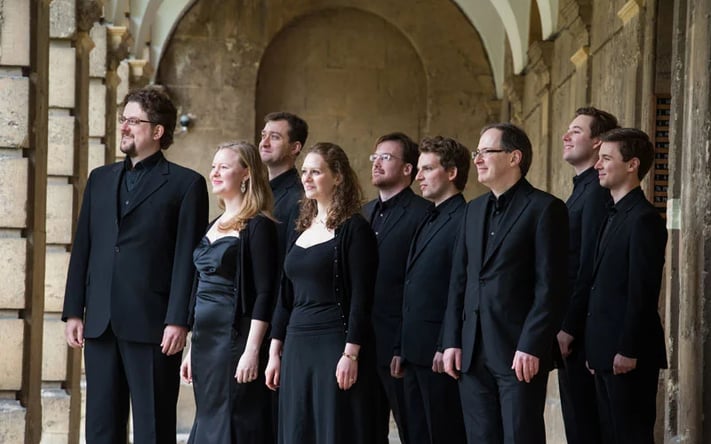
For those concerned that Christmas has lost its spirituality, those who regularly bemoan its increasingly secular commercialism, and those simply needing a reminder of the inspiring beauty of Christmas choral music – for all of them, the solution was to be seen and heard in the magnificent Chapel of The Queen’s College.
The small vocal ensemble Contrapunctus, under their distinguished conductor Owen Rees, presented an eclectic selection of music for Christmas drawn from the past five centuries. However, far from just sharing with the packed audience a chronological survey of the vast repertoire that has enhanced Christian worship over that time, the imaginative programming provided an illuminating insight into the timelessness of the Christian story.
Throughout their recital, the eight singers – all worthy soloists in their own right – succeeded in tracing a line of aural wonder and ethereal beauty in the five groups of carols, ranging from the hugely influential giants of the past, including Tallis and Victoria from the sixteenth century, right up to music of the twenty-first. The sheer variety itself was part of the enthralling journey, on which the audience was accompanied by the exceptionally informative programme notes (modestly unattributed but likely the work of Owen Rees).
The recital opened with two starkly contrasting modern pieces, John Tavener’s “O do not move” (appropriately almost motionless in its mesmerising tone) and the tightly rhythmical setting of “Adam lay ybounden” by Howard Skempton, which the choir brought to a rapid climax of telling splendour on the words “Deo gratias”. The stage was set for an effortless leap back to the Renaissance and the purity of the Contrapunctus tone, their perfectly balanced imitative entries and agonising false relations in Thomas Tallis’ “Videte miraculum”. Without wishing to be sacrilegious, one could have substituted the Latin exhortation “Audite” for the verb in the title, so miraculously blended was the choral sound.
As the concert progressed, Rees brought the audience into more intimate contact with the music and its background through his engaging introductions. He wears his consummate scholarship lightly, able to give just enough historical context and musical insight to enhance the listener’s appreciation.
One link across the ages occurred in the contemporary composer David Blackwell’s setting in English of the German carol “Es ist ein’ Ros’ entsprungen”: A magical surprise awaited us with a startling chord reminiscent of the similarly unexpected A major chord towards the end of Tallis’ own “Spem in alium”. The familiar “Gaudete” that followed was accompanied by Rees on tambourine, ensuring the metronomic rigour of the performance. One of many highlights was Michael Praetorius’ setting of “Resonet in laudibus”, the clarion sopranos reflecting the title, with a fitting climax at the news of the annunciation by Gabriel.
And so the delights continued, through the familiar (Tavener’s “The Lamb”), the perhaps unfamiliar but affecting (the anonymous seventeenth century “Swete was the song the Virgine soong”), and a combination of both, in Fredrik Sixten’s enchanting “Mary’s Lullaby”, aptly described as a “jazz-inspired transformation” of the famous “Silent Night” melody.
At every stage, the octet breathed harmony, and in harmony, creating seamless, endless musical lines almost always with exquisite balance, although just occasionally one voice or another appeared too dominant. The range of emotion conveyed was astonishing, from the joy of Sweelinck’s setting of the words “Alleluia, Noe” to the ineffable sadness of the central section of Byrd’s “Lullaby, my sweet little baby”. Visually, the singers’ eyes rested to an unexpected extent on their music, with glances of course at the conductor. But they might have brought even greater spontaneity and communicated more directly with the audience had they sung, perhaps just for one or two items, without a conductor at all, so perfect was their preparation by Owen Rees.
Yet this Contrapunctus recital was a rare treat - eight solo voices bringing striking understanding and intense engagement to such varying styles of Christmas music, emphasising both the spiritual importance of the story and the overwhelming beauty of the music. Their next Oxford concert should not be missed.