





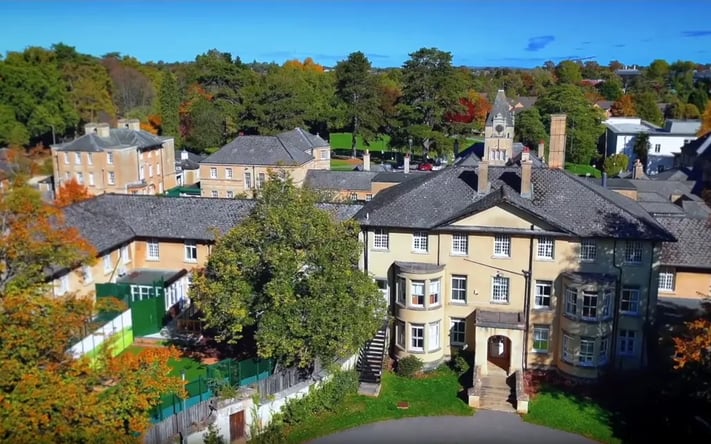
There is a detail early in this film that stays with you long after the credits roll.
In the hospital’s first years, patients planted fruit trees in the grounds. They tended them through the seasons, watched them fruit, and eventually harvested them. The film suggests some of those trees — or their successors — may still be standing. It doesn’t labour the point. It doesn’t need to.
The History of the Warneford, specially commissioned to mark the hospital’s bicentenary and screened at Oxford Brookes as part of the Warneford 200 programme, is that kind of film. Quietly confident. Content to let its images do the work.
What it does well is hold two hundred years lightly. Funded by the National Lottery Heritage Fund, it moves from the hospital’s founding in the 1820s — a small refuge on the edge of Oxford — through the full sweep of psychiatric history: the era of therapeutic routine and kitchen gardens, then medical intervention, insulin therapy, the pharmaceutical revolution of the mid-twentieth century, and finally back toward something older. Community. Environment. The particular value of connection to place.
Each era, the film gently implies, believed it had found the answer. The cumulative effect is humbling rather than damning — this is a generous piece of work, more interested in understanding than in judgment.
Woven throughout are excerpts from Within These Walls, a play by Janet Bolam produced by Human Story Theatre, drawn from case studies in the hospital’s own archives. These dramatised moments — brief, carefully chosen — open windows into patient experience that statistics and clinical timelines cannot. They are most powerful in the earlier periods, before medication reshaped what treatment looked like, when what the archive holds is closer to raw human testimony.
The hospital’s physical landscape runs through the film like a spine. The historic buildings, the meadow, the particular quality of light across those Oxford grounds — these aren’t just backdrop. The film understands, as the moral treatment pioneers of the 1820s understood, that environment is not incidental to recovery. It is part of it.
The film concludes by looking forward — a new hospital building planned for the site, the original Warneford structures to become a postgraduate college. Change, again. Repurposing, again.
But those fruit trees are still there.
And that, the film quietly suggests, might be the most important thing it has to tell us.