





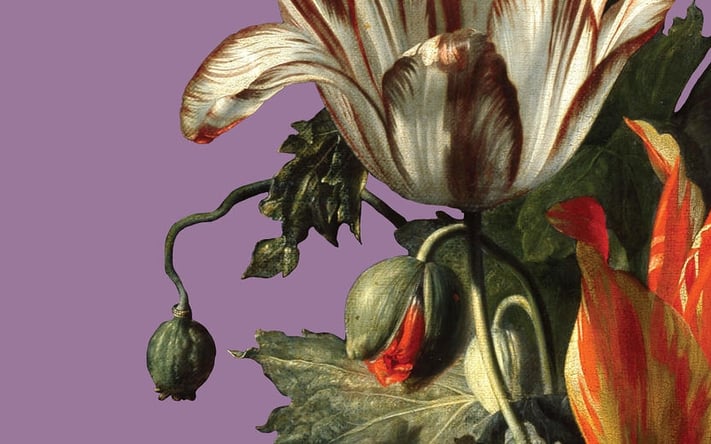
There’s a moment in The Good Place when afterlife architect Michael outlines the countless human decisions and consequences that go into the purchase of one simple tomato: “just buying a tomato at a grocery store means that you are unwittingly supporting toxic pesticides, exploiting labor, contributing to global warming. Humans think that they're making one choice, but they're actually making dozens of choices they don't even know they're making.” While the flora and fauna of the Ashmolean’s In Bloom are a good deal more aesthetically pleasing than the humble fruit Michael uses to make his point, I couldn’t help but recall that scene while moving through its chambers. Poppies, tulips, roses, tea leaves; these are plants whose import over the centuries have shaped not just our aesthetic but our economic and geopolitical landscape. And the displays depicting them are gorgeous to look at (and in some case, to sniff!), but throughout there is an underlying hum of their troubled legacy that by the final room has grown into a shout.
Our first room focuses largely on the birth of modern botanical study in the 15th century, through the rise of horticulturalists and naturalists like John Tradescant, Mary Somerset and Charles Linnaeus. As one wall display puts into sharp relief, this was a period of intense cross-pollination between collaborators as this burgeoning field grew and bore fruit. It very effectively establishes not just the academic vigour put behind the study of plant life, but how crucial the work of artists were in helping them achieve it.
Extraordinarily thick tomes of plant cataloguing are embellished with intricately detailed and impressively accurate illustrations from Everard Kick, Maria Sibylla Merian and James Caldwall, these enterprises often debilitatingly expensive for their commissioners. In the room’s centre, a set of beautifully crafted teaching models sit under bell jars - more than just an aesthetic exercise, the accuracy of these depictions was crucial to imparting new knowledge of plant anatomy.
Even here, though, there are hints of the imbalanced power structures at the heart of cultivation. As the museum’s caption “for the curious and the wealthy” implies, this was a discipline dictated by access to wealthy patrons. Colonial implications rear their head too in a map of Native American territories, where John Tradescant travelled to the Jamestown settlement to collect new plant species.
The second display has an especially sensory quality to it. Light and airy, with the soft sounds of running water, diaphanous green awnings and even little trumpets of scent for you to sample, it has the air of a greenhouse - appropriate, as this section examines the adoption of previously exotic plant species into everyday life, and their impact on the artistic landscape. It seems during this period you couldn’t go for more than a few decades without a new ‘florimania’ springing up, from Dutch ‘tulipomania’ to the Victorian obsession with roses proliferated by the introduction of new species from China and the Ottoman Empire.
The Ashmolean takes care to include examples from the plants’ countries of origin as much as of their adopters, such as a Turkish fritware plate with a rose and tulip motif and a carved box with details so minute you can actually recognise individual breeds of rose. Of course, the economic as well as the aesthetic impact is felt here, namely in the displays related to the poppy and tea trade. Again pairing together Chinese artefacts (a tea brick, a wood carving of opium smokers) with British paraphernalia, they succinctly summarise how these customs became absorbed into British economic and imperial interests, sometimes, as in the case of the 19th century opium wars, with bloody consequences.
There’s something faintly, and most likely intentionally, unsettling about the appropriative exoticism you can sense here; Kew Gardens’ anglicised ‘Mosque’ and ‘Alhambra’ in etchings by Rooker, Herbert David Richter’s ‘The Indian Shawl’ depicting the fashionable Asian commodities adorning Victorian parlours. It’s an apt summary for enterprises like the monocultures developed at Kew, picking and choosing those parts of an unfamiliar culture viewed as most fashionable or profitable, and diluting them for public consumption at the expense of their original ecosystem. Juxtaposing them with more traditional floral depictions here is quietly subversive - we appreciate their visual beauty as the Victorians did, but we cannot ignore the context behind it.
And in the last gallery that context comes to fruition. We are led in via my personal favourite contribution, a collection of works by Anahita Norouzi. What the previous collection has hinted at, she throws into confrontational relief. ‘What’s in a Name’ brings together unsettling floral hybrids that look as though they have been dipped in crude oil; based on Iris barnumiae, originally from northern Iran, the piece is a sobering reflection of the plant’s cultural and aesthetic bastardisation in its cultivation for Western consumption, a commentary that feels especially timely. Her accompanying piece, ‘Circuit of Disposession’, actually does incorporate crude oil into its construction. Designed to evoke both an iris and a Rorschach test, the series of prints is boldly stamped on copies of archival documents recording the Anglo-Persian Oil Company’s acquisition of Iranian land in the 20th century. These, to me, are the most arresting and politically challenging pieces in the collection.
Overall there’s a greater sense of human (and animal) interest in these last contemporary displays; Kate Friend’s photography series ‘As Chosen By…’, for instance, lovingly documents flowers that have been selected by public figures for personal, rather than economic or fashionable, significance (that being said, we may have moved beyond aristocratic patrons, but you can’t say Anjelica Huston or Ai Wei Wei don’t still hold a ton of cultural capital).
Similarly, where In Bloom’s earlier illustrations of plant species were done out of academic curiosity, Isik Guner’s masterfully detailed studies are done out of an almost furious necessity. Blown up to human proportions, they force the viewer to reckon with the plant close up as more than an object of detached study, a vital attitude to have if we are to conserve species for the future. It’s a philosophy mirrored in two large scale tapestries by Alexandra Daisy Ginsberg, the saturated, almost psychedelic palette of which intends to mimic the vision of bees and butterflies. Ginsberg’s work is informed by her ‘Pollinator Pathmaker’ program, which creates planting designs based on encouraging local biome diversity - if you’re going to use artificial intelligence in your art, this is how you do it right.
In their own terrariums sit a series of installations from Justine Smith, whose ‘flowers’ made of repurposed bank notes call to mind Susan Stockwell’s ‘Money Dress’ from the Ashmolean’s Money Talks exhibition a few years prior. It’s a smart subversion of what we’ve seen in the prior room, the tools of capital not just controlling but embodying their object, and Smith uses it to make some pertinent commentary about the fragility and delicate balance of the political ecosystem.
And we come full circle with a modern reply to the academic practice that set all this in motion. Fran Monks’ photographic portraits hearken back to Tradescant’s portrait in the first gallery, depicting Oxford scientists representing their vocation, but there’s a down-to-earth authenticity and warmth to them that speaks to a shift in academic culture over the centuries, one that (hopefully) will use fields of study like botany to serve the collective good, independent of wealthy patrons or economic conquest. Seeds can start empires or they can start revolutions; it all depends on what we choose to nurture.