





It’s been quite refreshing this year to see the Oxford Shakespeare season adopt a slightly darker edge with its choice in productions. Where last year saw many a yellow tight and mischievous fae, Oxford Castle has been adding a bit more acid to the palate in 2026 with the grim political machinations of BMH’s Julius Caesar now giving way to the ruthless ambition of Macbeth, here in the hands of Wild Goose. I caught the team’s Much Ado last year and had a lovely time with it, so I was intrigued to see how they would approach some grimmer fare from the Bard - certainly having Oxford Castle as a setting opens up some suitably spooky possibilities.
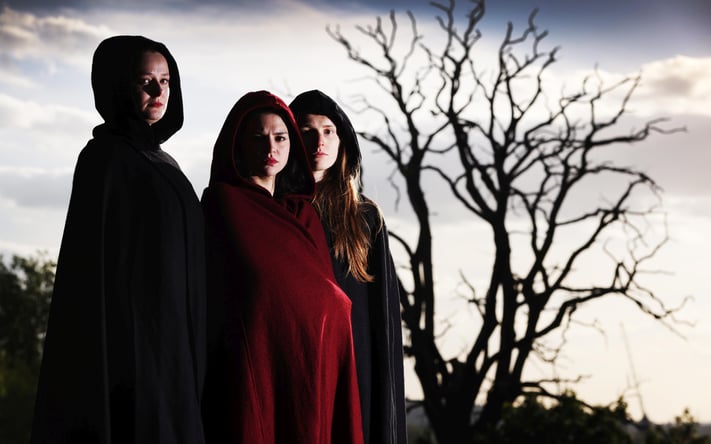
With its gaggle of witches, its gory body count and its monkey’s-paw approach to poetic justice, Macbeth is the Shakespeare tragedy most closely aligned to supernatural horror. Wild Goose lean into this in their production design: the jagged, stylised tree arch calling to mind German expressionist horror cinema, while the chessboard dais, dark hooded robes and fondness for skulls displayed by the witches feels distinctly Seventh Seal-ish. But it’s also in how the witches are utilised, with Gretel Kahn, Natalia Ramli Davies and Emily Davies appearing throughout in the guise of messengers, serving maids and sentries. Their insidious, constant presence is a great touch that effectively conveys how little control Macbeth actually wields over his own fate.
As for our Thane himself, Craig Finlay translates his naturally affable stage presence into a Macbeth that feels much more like a noble man corrupted than a man already nursing a darkness within him that needs only the slightest push. There is something to be said for both approaches, but the kind of warped heroic impulse Finlay portrays here, one that progresses from delusion to full mania, is compelling in its own right, with the sense always that this is a man in way over his head.
And as ever behind every scheming man, there has to be a more competent scheming woman to get the job done. Rachael Twyford’s Lady Macbeth is especially arresting in her final, fraught moments, flitting between whispered admonishments and keening howls, but I do wish there had been more variation in tone in her journey to this point. You can always rely on Twyford to deliver Shakespeare’s words with near musical fluidity, but her delivery, whether addressing Macbeth or Duncan, doesn’t really vary beyond declarative, earnest entreaty, so we get less of a sense of the character’s adaptability or skills as a master manipulator, as well as less of a contrast between her earlier ruthlessness and her ultimate abjection.
Billy Morton as Banquo bears his suspicions for his friend’s new fortune with stoic resolve. You really feel the sense of a bond broken between the pair, and Morton’s unblinking pursuit of Macbeth as Banquo’s phantom is unnerving when it has the staging on its side (more anon). Joel Watson charts the growing maturity of Malcolm on his journey to take his rightful place on the throne, and Mary Stuck makes for a distinguished but vulnerable Duncan. Finally, John Gaughan as Macduff can summon gruff military fervour and dissolve it into a broken man mourning the loss of his entire clan. His fight scene with Macbeth is one of the highlights of the show, well choreographed and with a feeling of genuine weight behind it.
Where the production fumbles slightly in certain aspects of its stagecraft. There are multiple dance sequences in the show, which work for a comedy but here do drag down the pace, and especially in the reveal of a ghostly Banquo, lessen the impact of what should be one of the play’s most chilling moments. It defangs the reveal when, so soon after his murder, Banquo is visibly on stage for the entirety of the feasting scene, even getting a boogie on with other guests, and would have been much more effective if his presence were more detached or obscured, not quite giving the game away but giving enough of a clue that one of these guests is not like the others. What’s frustrating is they actually manage this brilliantly not moments later when Morton reveals himself a second time, suddenly materialising at an opposing door and walking It Follows-style towards Finlay with measured but relentless menace.
The soundtrack too is a curiously jarring mishmash of genres, veering from a mellow, easy listening track for earlier transitions to Glen Miller, synthy rock guitar and even at one point what sounded like dubstep. I don’t know if the intention was to be deliberately anachronistic but it just doesn’t mesh with the very 30s-40s costume design and makes for a bumpy soundscape to navigate through. Music sometimes faded in and out too abruptly during dialogue sequences or played while the stage stood empty for longer than seemed intentional (though I’m sure this will be refined as the show continues its run). There’s also an absolutely egregious 10-second soundbite employed for a limp, out-of-place ‘orange man bad’ dig at Donald Trump that mars an otherwise very strong comic performance from Jordan Bische as the Porter through no fault of his own. Look, there are many things you can and should call Trump, but an ‘Equivocator’ would not be first on my list. In fact I would say the man’s main problem is that he’s TOO clear on what his opinions are, as evidenced by the very clip they use.
But there are other big swings that really shine, particularly an affecting sequence during Lady Macbeth’s “unsex me here” speech. As she declaims, the witches gradually fit her with a bulletproof vest before solemnly raising a pistol and pulling the trigger. Lady M staggers up, shaken but resolute, a novel and imaginative staging of the incantation that marks her as a participant on this battlefield. I would have loved to see more of that distinctly militarised vision play out. As it stands, Wild Goose’s Macbeth is a solid, faithful retelling with some thoroughly inventive touches (if occasionally questionable ones), bolstered by a universally strong ensemble - no strutting or fretting from this bunch. Catch it at the Castle for the rest of this month, and see it twice to catch both Finlay and Morton’s takes on the Thane of Cawdor.