





Oxford Inns
"When you have lost your inns, drown your empty selves, for you will have lost the last of England."
- Hilaire Belloc
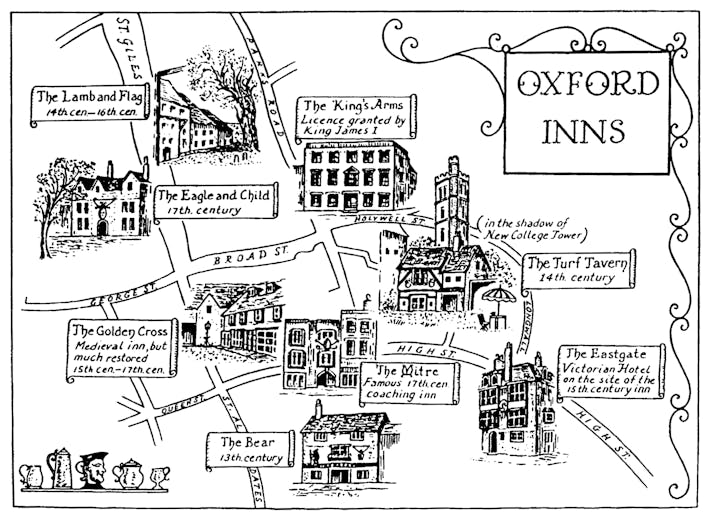
There are about 115 pubs in Oxford, many dating from coaching days, when this was an important centre. In spite of Brewery takeovers and modernisations, Oxford's pubs for the most part retain their individual characters.
The Golden Cross is the site of the oldest Oxford Inn. Its landlord was prosecuted for selling wine on the black market in 1285, and in 1388 it was bought by William of Wykeham (the founder of New College). It remained New College property until 1825.
The King's Arms is sometimes known as 'Wadham College annexe', and was the last pub in Oxford to relinquish its men's only room (c.1973).
The Bear tends to be taken over by Christ Church men in term time. It exhibits a collection of snippets of customers' ties, begun in 1952, denoting membership of clubs, regiments and similar. A free pint is provided along with the scissors.
The Turf Tavern is reached by Hell's Passage, named after a gambling hell. It is likely that the pub's own name had something to do with turf accountants.
The Mitre and The Eastgate are mainly for businessmen, though they are still considered suitable places for the termly parental dinner. The Mitre (now a Beefeater) as been a feature of University life for centuries, and often appears in Oxford fiction. Its central position has made it the scene of many a drama, and until 1921, it was still possible to visit the priest's hole, where Roman Catholic priests could hide from their persecutors. There is a story that in 1683, three drunken fellows of All Souls coming late at night to demand food, so terrorised the landlady that she died of fright.
The Eagle and Child, nicknamed 'The Bird and Baby', was the regular meeting place of CS Lewis and 'The Inklings', who included JRR Tolkien among their number.
Historic Inns by the Thames
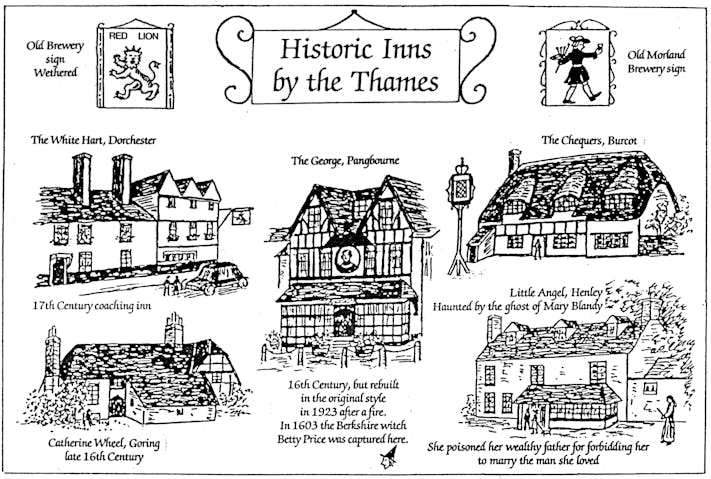
The White Hart, Dorchester, is a coaching inn dated 1691, which may be older than this. It is now a luxury hotel.
The Catherine Wheel, Goring, is a sixteenth century inn. This used to be the main street (Ferry Lane) until the bridge was built in 1837.
The Chequers, Burcot, is a traditionally built pub – thatch over timber frame.
The Little Angel (officially the Angel Inn) is in Henley, but across the bridge on the Berkshire side of the Thames. In 1752 Mary Blandy fled across the county boundary and hid here, but was later arrested and hanged. In 1969, when a play about her was being rehearsed, the presence of a mysterious woman was noticed.