





Oxford Canal
The canal was used mainly to transport cheap coal and timber from the Midlands, barges being ideal to convey bulky resources long distance, although perishable goods were prey to bad weather conditions. However, in 1795 a severe winter brought home the problem of too great a reliance on the canal, as traffic stopped due to the ice. For ten weeks Oxford suffered distress and poverty without coal, until a fresh supply finally managed to get through on 4th March.
The arrival of the railways rapidly affected the amount of commercial traffic on the canal, but it was only after the Second World War that the waterway fell virtually into disuse - between 1942 and 1956 the number of boats using the canal to Oxford fell from 223 to 16. The final straw was another cold spell. In the winter of 1962-3 the canal network froze solid for months. Now the canal is mainly used for pleasure and residential craft, particularly during the summer months. The infant leisure industry was given a huge boost by Tom Rolt's book Narrow Boat, an account of a honeymoon canal trip starting from Tooley's Boatyard in Banbury.
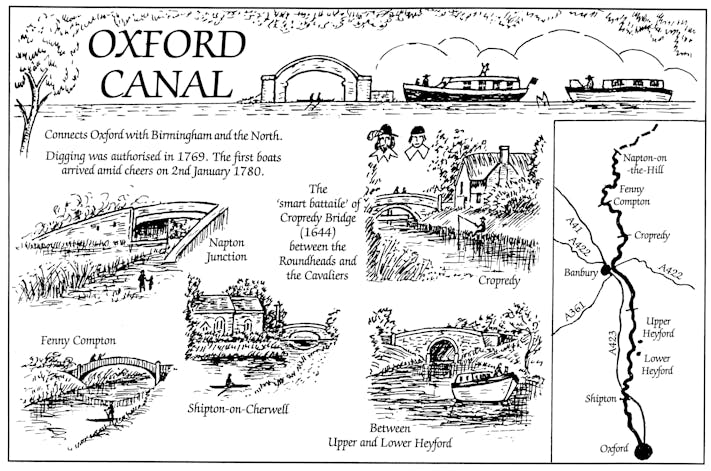
The bridge at Cropredy figured in a battle between the Roundheads and Cavaliers in late June 1644. General Waller seized the bridge for Cromwell and crossed it, managing to create a gap in the King’s forces and nearly compelling their surrender. However he hesitated, and a counter-attack saw the royalist troops regain possession of the bridge. The Royalists’ success, however, was overshadowed when, 3 days later, the apparently invincible Prince Rupert suffered a shattering defeat at Marston Moor. At the time Cropredy bridge only spanned the river Cherwell, but now the Cherwell and Canal run very close side by side.
The Coming of the Railway
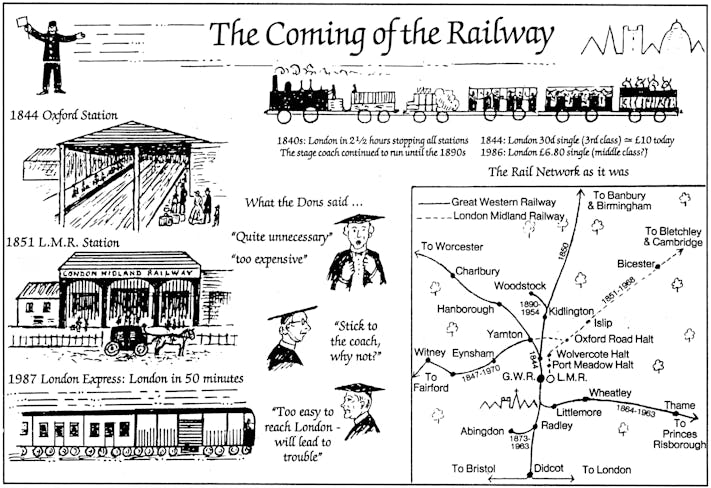
The University was initially hostile to the railways. Christ Church opposed a scheme to build the first station on their land near Magdalen Bridge, and the Duke of Wellington – Chancellor of the University – was an inveterate opponent. For a number of years, the nearest station was at Steventon, 10 miles south of the city. It was served by eight coaches daily, which took one and a half hours, and cost three shillings.
When the line eventually opened, on June 12th 1844, the station was at Grandpont, just south of Folly Bridge. The usual excuse for the late return of undergraduates at the beginning of term had always been the state of the roads. Now it became the state of the railways – a hazard whose existence some of the older dons refused to acknowledge.
The original Oxford-London line was built on a wide gauge, backed by Isambard Kingdom Brunel. When the narrow gauge faction eventually won the argument, the line had to be taken up and relaid at its present width of 4'8.5".
In 1852, a new Great Western Railway station was built on the present site, opposite the London Midland Railway terminus of 1851. This LMR station used the technique of prefabricated ironwork pioneered at the Great Exhibition of the same year, and was closed in 1951. Oxford's present station was built in 1972; plans to redevelop the site as a more fitting entrance to the city are to be welcomed.
Our map shows the railway network at its height. Until 1968 it was possible to take the Brain Train to Cambridge. The service to Woodstock stopped in 1954 – a man of 86 who had helped to build the line was a passenger on the last train.
Since this cartoon, the Oxford-Marylebone line via Bicester has been updated, and a new station opened at Oxford Parkway, cutting down commuting time to London from the northern half of the county. There is some talk of reopening to commercial tarffic what remains of the Oxford-Wheatley branch line, which currently only carries industrial traffic between Oxford station and the Cowley BMW plant.