





Tall Tales and Odd Dons
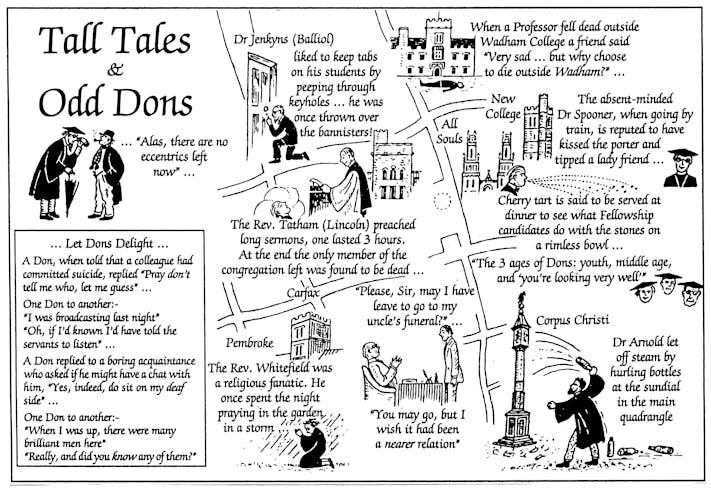
We take no responsibility for the truth or otherwise of these tales.
The answer to what to do with one's cherry-stones at All Souls' has never been divulged. To gain entry as a Fellow is considered the height of academic achievement, and before one reaches the alleged cherry-stone stage, a terrifying academic ordeal has to be negotiated. The final paper is perhaps the most demanding: a single essay, to be written in three hours, with a one-word title. In 1985 the word was 'Discretion'. A few years before that it was 'Green'. Fellowships last for seven years during which time the fellows are provided with free rooms and dinners, and the freedom to conduct their research. There is also a small stipend (£4,655 in 1986). The only formal requirement is to pernoctate (spend the night in Oxford) for 84 days in the first year.
The sundial at Corpus seems to be particularly unfortunate when it comes to dons letting off steam. Even the mild-mannered Keble is said to have hurled a bottle at it in a rage!
Curious Dons and Clever Pets
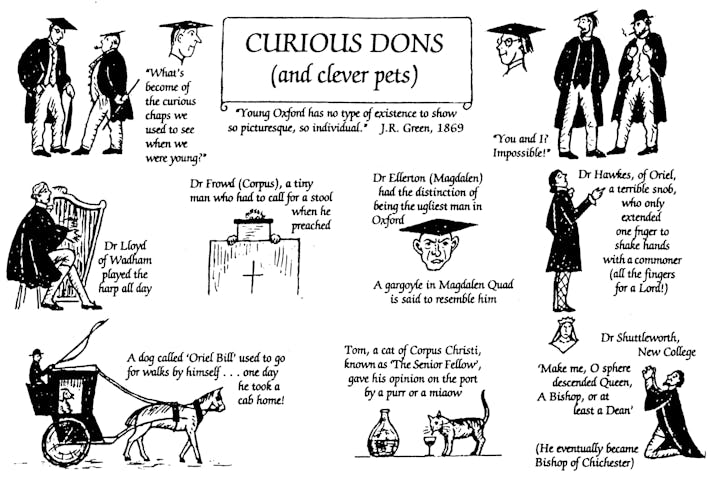
Around the new millennium, Pembroke College had a black cat called Molly, who was officially "owned" by a succession of organ scholars and had been taught to drink out of champagne glasses. During the day she used to nip out over the tiles, cross Brewer Street, and head to the sofa shop, which occupied the building on the corner of Brewer and Littlegate Streets. There she would stretch out on the display models under the halogen lamps. The sofa shop would ring the college to fetch her back, whereupon the porters would deny all knowledge of her existence. For a while this happened daily.
Curious Characters
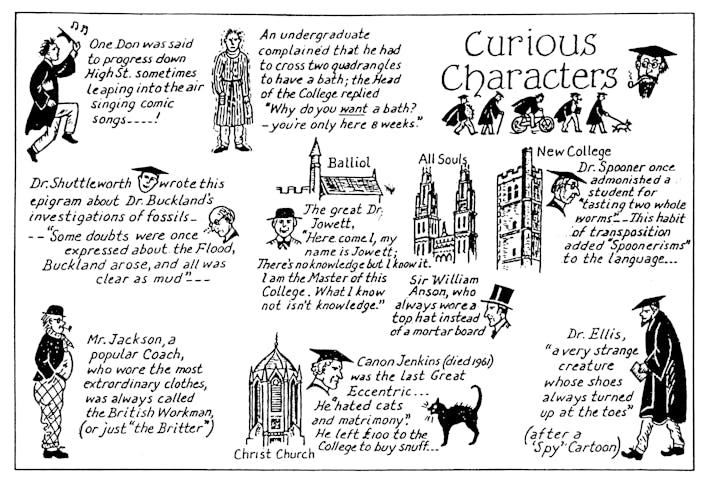
Spooner, who was Warden of New College from 1903 to 1924, was albino. He inspired great affection among his students, who delighted in immortalising his occasional slips in speech. One of his most famous utterances (possibly apocryphal) runs as follows: “You have tasted a whole worm. You have hissed my mystery lectures. You will leave by the town drain.” It was Spooner who caused a memorial to be erected in New College Chapel to those members of college who died fighting on the enemy side in World War I: “In memory of the men of this college who coming from a foreign land entered into the inheritance of this place and returning fought and died for their country in the war 1914-1919”.
Eccentrics
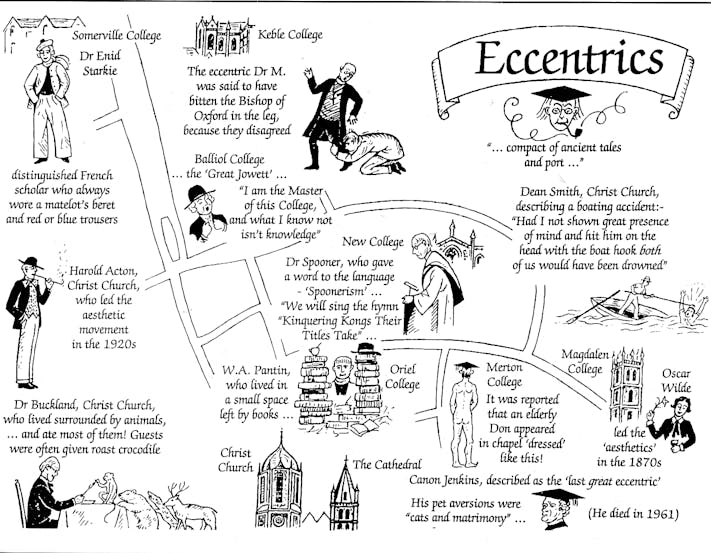
First published in The Oxford Calendar, 1977
In the single-minded pursuit of their subjects some academics become detached from the ordinary things of life. Fewer do so now, perhaps because more are married and their wives won’t have it.
A side effect of dons’ detachment was disinterest in modern facilities. When, in the 1950s, Pembroke undergraduates complained of a lack of washbasins and baths, the Master was reputed to have said “What do they want baths for? They’re only here for eight weeks.”
Jowett was a great educationalist, who nevertheless tended to intimidate those he attempted to help. AJC Hare recalled: “Walking with this kind and silent friend was...a terrible ordeal...He scarcely ever spoke, and if, in my shyness, I said something at one milestone, he would make no response at all until we reached the next, when he would say abruptly, ‘Your last observation was singularly commonplace’.” Jowett was responsible for that invaluable piece of advice: “Never retreat. Never explain.” He also maintained for many years a passionate correspondence with Florence Nightingale. When asked what she was like, he replied: “Violent, very violent.”
A pupil of WE Pantin recounts that on one occasion he was reading out his essay when Pantin stopped him over a point it was necessary to verify in one of his many books. The student was directed to the third stack in the fifth row - seventh book down. Sure enough the relevant passage was there - marked by a bacon sandwich. On another occasion, during the World War II blackout, a guest asked Dr Pantin if he might use a torch to find his way across the quad. The answer was negative, but nicely put: “Dominus illuminatio mea.”* Pantin’s subject was History. If ever a gap was discovered in his knowledge, he would mutter: “Not my period.” If pressed, he would declare his period to be English Church History from 1350 - 1375.
*The University motto: ‘God is my light’.
Undergraduates Famous and Infamous
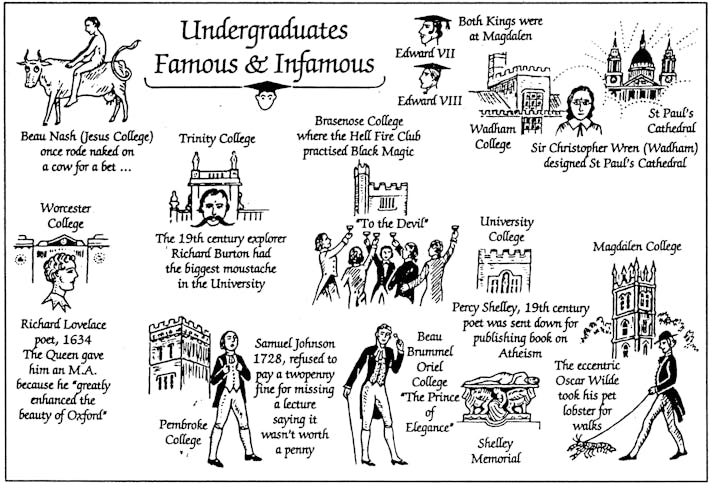
Richard Lovelace was a Cavalier, who joined the Royalist forces in Oxford in 1645-6. It was he, who gave us the lines: “Stone walls do not a prison make, Nor iron bars a cage.” They gain credibility when one discovers they were written while in prison. Technically, Christopher Wren was a fellow-commoner at Wadham- that is a student of superior birth who paid extra for High Table privileges. He went on to be a Fellow of All Souls. He designed the Sheldonian Theatre in the 1660s, and the upper half of Tom Tower, Christ Church, in 1681-2.
Beau Nash and Beau Brummel were regency dandies.
In Samuel Johnson’s time at Pembroke, servants were sent regularly to knock on students’ doors, to check that they were inside, working. If there was no answer, their absence was reported to the Master. This so infuriated Johnson that he refused to admit to his presence even when he was in, and he frequently got into trouble over this. He was not an assiduous student, and used to cross the road to Christ Church to borrow a friend’s lecture notes. he had to discontinue this habit when his shoes became so worn that the Christ Church men laughed at him. Unable to afford to replace them, he nevertheless threw away in a fury a pair of new shoes left outside his door by an anonymous donor. Johnson left Oxford after about a year, but like may people who have not stayed long enough to obtain a degree, he took a great delight in the place in later life, and loved showing people around.
Sir Richard Burton (nothing to do with the actor) came up to Trinity College in 1840, but stayed only five terms, during which time he resisted all efforts to persuade him to trim his moustache. He “withdrew” from Oxford, and reported to his family that he had been awarded “an extra vacation for taking a double first with the highest honours”. In truth he had been rusticated (sent down) for deliberately getting into trouble in order to avoid being made to enter the Church. Instead, he became an explorer, often travelling disguised as a native in order to live among the people. From India he went on to Africa, where he discovered Lake Tanganyika, and searched for the Upper Nile (where, we are told, his face was transfixed by a spear from cheek to cheek).
Oscar Wilde, who came up in 1874, having taken his first degree at Dublin, was a brilliant, if erratic student. He loved Oxford, and was disappointed not to be offered a Fellowship at Magdalen. One of his tributes to Oxford appears in Lady Bracknell’s line in ‘The Importance of Being Earnest’: “Untruthful! My nephew Algernon! Impossible! He is an Oxonian!”
Rumour has it that the Shelley Memorial was intended for his tomb, but the English Cemetery in Rome refused to accept it. Over the years the Memorial has been subjected to a number of indignities, including being painted orange, supplied with underpants, adorned with signposts, mummified in roller towels, surrounded by bottles with a notice reading “The Morning After”; or flooded, with goldfish to add verisimilitude. These are but a few shining examples of the inventiveness of Univ men (and women), and while some of them may be apocryphal, it is tactful to give them credence when in the presence of a member of the college.