





|
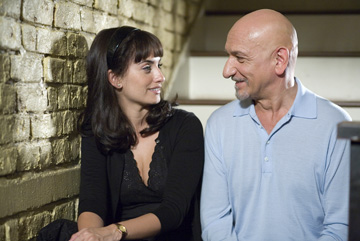
A moving unforgettable piece about love and death, well acted and painfully realistic. The awkward awakening of consciousness about the reality of the other. Both lovers see images which are then confronted by extra-relational impingments. She sees the successful professor, he has difficulty seeing past her beauty. Neither really sees the other. Gradually, there is an awakening, one where her beauty fades and his perception of her becomes evident. She, frustrated by his immaturity, also faces the loss of an ideal. At the end, an uncomfortable tenuous bond unites them. There are also side gems such as the professor's difficult son and their mutual anger and its gradual resolution. Then too, the abiding friendship with his colleague, and the other "older woman" bed mate. vonk (DI User), 13/08/08 Elegy is a movie adaptation of Philip Roth's novella The Dying Animal. I confess to not having read the story in question, but I was intrigued to see this film after finding out that a woman - Isabel Coixet (My Life Without Me) - was directing. Given that what I do know of Roth includes the accusations of misogynism which have been levelled against him, I was curious to see what treatment a female director would give this story, a subtle tale of a love affair between aging college professor David Kepesh (Ben Kingsley) and his beautiful young student Consuela (Penelope Cruz). Would Coixet redeem a character whom we soon see is blatantly sexist and selfish, or would this movie be an opportunity to criticise such attitudes, using the illness of the only woman it appears David has truly loved as an indictment of them? The result, it appears, is somewhere in between, which may partly be due to the fact that Coixet consulted extensively with Roth during the film's preparation. OK, so the story. David is a confirmed bachelor, having run out on his wife and son (a wonderfully bitter Peter Sarsgaard) many years earlier. He and best friend George (Dennis Hopper) get together weekly to discuss their latest sexual liaisons and David regularly has no strings sex with old friend Carolyn (a sparky but fragile Patricia Clarkson). His only frustration stems from self-loathing at his aging body, which he sees as off kilter with his still urgent sexual desires. His libidinous interest in his students seems motivated by a wish to blot out the encroachment of old age and initially his involvement with Consuela just seems like another distraction. However as their relationship develops, David becomes obsessed by Consuela, paranoid she will leave him for someone younger whilst at the same time unwilling to commit to her as she dearly wants him to. After he lets her down once too often, Consuela leaves him and David is forced to recognise the time he has wasted by not committing, and also his own mortality after the death of a close friend. A separate turn of events towards the end of the movie paves the way for the possibility of his moral redemption, with the return of Consuela and the revelation of her cancer diagnosis. This is an intelligent movie with a string of incredibly strong performances - it goes without saying that Ben Kingsley is superb as a complex and not altogether likeable man; his scenes with Dennis Hopper are wonderful to watch. Hopper is also on form as a philandering husband whose reconciliation with his wife is too late to make a difference to their marriage. Penelope Cruz also deserves recognition for her performance; she holds her own with Sir Ben and affords Consuela a gravitas which makes her more than just a token, tragic naive ingenue. The themes of aging and mortality which are central to the story see the male characters desperately clinging to their youth in what is the film's tragedy - they hurt others through their selfishness. The passionate love story which prompts David's self-reflection is played out quietly but movingly with some beautifully tender love scenes. Admittedly, Elegy has as many bleak moments as it does beautiful ones and is slow moving for such a short film - it won't be to everyone's tastes. However, I recommend this movie. The film's ambiguous ending is tinged with sadness as well as hope and perhaps sums up the creative compromise between source and adaptation, as well as the effects of David and Consuela's affair. An intellectual weepy. Lindsey Davis (Unverified), 11/08/08 |
Latest Cinema reviewsHaywire [15]: Come on it ain't that bad! The Bourne Ultimatum (with a dash of Our Man Flint) comes...read more Carnage [15]: Words are wasps in Carnage, Roman Polanski’s adaptation of Yasmina Reza’s black comedy....read more J Edgar [15]: Handsomely mounted but ploddingly executed, J Edgar is a disappointing film. For...read more Haywire [15]: This is truly the worst film I have ever paid to see - and at £9+ for the tickets...read more The Artist [PG]: There is something quite nostalgic about watching a silent, black and white film...read more Review of the DayValentine's Day 2012: To my lovely Snookums, Thanks for always making me laugh! Love ya!...read more Please fill in the boxes and then click "Send Review" to submit your review for Elegy [15]. |