





March 24, 2010
This is a complex, provoking and profoundly ambivalent play – supposedly a clear critique of tyranny, the play was first performed – by permission – in Nazi-occupied Paris in February 1944. In that context, we are told, French audiences could identify Antigone’s heroic resistance to Creon’s oppressive regime with their own more or less passive resistance to the Nazis. But that rather begs the question of what the Nazis in the audience got out of it; Anouilh was not chucked in prison for writing this and continued to live comfortably in the public eye for the duration of the occupation. As this production makes very clear, the play is far from identifying Antigone as the goody and Creon as the baddy.
Thebes has just been devastated by a civil war between Eteocles and Polynices, the two sons of Oedipus. They killed one another in single combat. The new king, Oedipus’ brother Creon, gives honourable burial to Eteocles, and decrees that Polynices’ body must be left to rot outside the city walls. Anyone attempting to give him proper burial rites will be put to death. Antigone is betrothed to the king’s son Haemon; they are in love and have every prospect of a happy life. But Antigone decides that her duty to her dead brother is more important than her own happiness and life, and decides to bury him even though she fully accepts that it will mean her death.
Antigone is in some ways very like a medieval virgin martyr – absolutely committed to her choice of defying the male authority figure who alternately tries to cajole and bully her into doing something she knows to be wrong. So far, so good. But like many virgin martyrs Antigone goes way beyond what a normal human being would consider to be reasonable in her perverse insistence that death and duty are infinitely preferable to life and compromise. She is in fact a very irritating personality, and as with the virgin martyrs, one feels a sneaking sympathy for her baffled persecutor, especially as Creon has no desire to execute her and is prepared to go to considerable lengths to save her life. But only if she gives in.
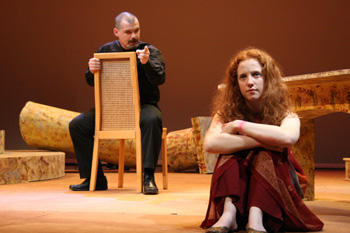
The contrast between an absolute, adolescent view of bravery and a nuanced, adult view of it was beautifully pointed in the casting of Jenni Mackenzie as Antigone and Joseph Kenneway as Creon. A slight, frail, girlish presence with a high squeaky voice and a cascade of Pre-Raphaelite auburn curls, this Antigone’s appearance and demeanour mask indomitable will, terrifying clarity of intellect, and a natural aversion to authority – the perfect terrorist. Creon is brilliantly personated by Joseph Kenneway as an overworked and harassed professional king, his crumpled, careworn face bearing witness that he much prefers negotiation and manipulation to straightforward butchery. His agenda is to bring stability to a city-state torn apart by the recent civil war, and he understands that leading a community and imposing order on it is a thankless task. He is far from being an evil brute, and is even the lesser bully of the two. Alistair Nunn is a likeable and sympathetic Haemon.
The one-man Chorus who introduces us to the legendary events behind the play and all the characters was played with effortless and masterful authority by Nick Quartley, his delivery light, deft and ironic, his face showing a detached, Olympian majesty. He flatly states that pretty much every character is doomed and that what distinguishes tragedy from melodrama is that there is simply no possibility of a happy ending – the characters are in the grip of forces beyond their control.
Anouilh brilliantly gives us a counterpoint to this statement by having Creon almost succeed in persuading his wayward neice that she should agree to his cover-up of her involvement. The audience has been warned that this cannot happen, but so strong is the desire for life and happiness that we almost believe he can change her mind. Anouilh generally stayed pretty close to the original Greek of Sophocles, for instance in having all the major events happen off-stage, but one of his most significant innovations was in this climactic conflict of wills in the second Act between Antigone and Creon. I won’t reveal how he does it, as it’s one of the great pleasures of this superbly dramatic text.
This is an outstanding production of a play that has clear resonance with modern times. Thoroughly recommended.
Thebes has just been devastated by a civil war between Eteocles and Polynices, the two sons of Oedipus. They killed one another in single combat. The new king, Oedipus’ brother Creon, gives honourable burial to Eteocles, and decrees that Polynices’ body must be left to rot outside the city walls. Anyone attempting to give him proper burial rites will be put to death. Antigone is betrothed to the king’s son Haemon; they are in love and have every prospect of a happy life. But Antigone decides that her duty to her dead brother is more important than her own happiness and life, and decides to bury him even though she fully accepts that it will mean her death.
Antigone is in some ways very like a medieval virgin martyr – absolutely committed to her choice of defying the male authority figure who alternately tries to cajole and bully her into doing something she knows to be wrong. So far, so good. But like many virgin martyrs Antigone goes way beyond what a normal human being would consider to be reasonable in her perverse insistence that death and duty are infinitely preferable to life and compromise. She is in fact a very irritating personality, and as with the virgin martyrs, one feels a sneaking sympathy for her baffled persecutor, especially as Creon has no desire to execute her and is prepared to go to considerable lengths to save her life. But only if she gives in.
The contrast between an absolute, adolescent view of bravery and a nuanced, adult view of it was beautifully pointed in the casting of Jenni Mackenzie as Antigone and Joseph Kenneway as Creon. A slight, frail, girlish presence with a high squeaky voice and a cascade of Pre-Raphaelite auburn curls, this Antigone’s appearance and demeanour mask indomitable will, terrifying clarity of intellect, and a natural aversion to authority – the perfect terrorist. Creon is brilliantly personated by Joseph Kenneway as an overworked and harassed professional king, his crumpled, careworn face bearing witness that he much prefers negotiation and manipulation to straightforward butchery. His agenda is to bring stability to a city-state torn apart by the recent civil war, and he understands that leading a community and imposing order on it is a thankless task. He is far from being an evil brute, and is even the lesser bully of the two. Alistair Nunn is a likeable and sympathetic Haemon.
The one-man Chorus who introduces us to the legendary events behind the play and all the characters was played with effortless and masterful authority by Nick Quartley, his delivery light, deft and ironic, his face showing a detached, Olympian majesty. He flatly states that pretty much every character is doomed and that what distinguishes tragedy from melodrama is that there is simply no possibility of a happy ending – the characters are in the grip of forces beyond their control.
Anouilh brilliantly gives us a counterpoint to this statement by having Creon almost succeed in persuading his wayward neice that she should agree to his cover-up of her involvement. The audience has been warned that this cannot happen, but so strong is the desire for life and happiness that we almost believe he can change her mind. Anouilh generally stayed pretty close to the original Greek of Sophocles, for instance in having all the major events happen off-stage, but one of his most significant innovations was in this climactic conflict of wills in the second Act between Antigone and Creon. I won’t reveal how he does it, as it’s one of the great pleasures of this superbly dramatic text.
This is an outstanding production of a play that has clear resonance with modern times. Thoroughly recommended.