





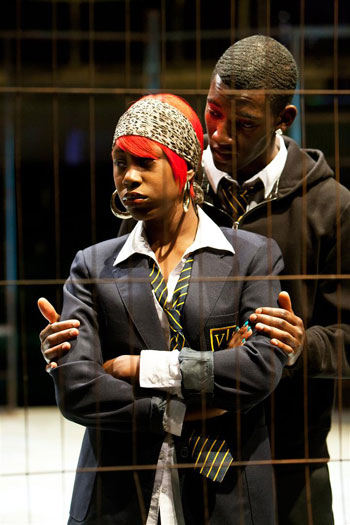
Mogadishu | Oxford Playhouse, Tue 14 - Sat 18 February 2012
The first full-length play by former teacher Vivienne Franzman, Mogadishu isn't set in the war zone you might be expecting - but has its share of violence and fear. Boldy opening in Oxford on Valentine's night, the fact that the house was full must say something about the city's lovers (though I'm not sure what).
Starting life in 2011 with its first run at Manchester's Royal Exchange, Mogadishu tells a tale from a tough inner city comprehensive (which you might place in London from the accents, but which would be plausible in several big British cities). Pulling no punches, the dramatic arc kicks in without preamble as we are presented with a playground fight ending with a white female teacher on the ground and a black teenage boy unrepentent. Thus begins a fast-paced journey of failed communication, bad decisions, lies and repressed and unexpressed emotions from which no character emerges triumphant or unscathed. In the brief cast-audience discussion which followed this opening night, actress Jackie Clune (teacher Amanda) described the piece as resembling nothing so much as a Greek tragedy - and you can certainly see what she means.
With a circular, cleverly revolving broken cage (basketball court? school perimeter fence? refugee camp?) enclosing all the action, and roll-off, roll-on furniture items setting each scene (breakfast bar for middle class teacher's home, standard issue padded easy chairs for school staffroom) - it's clear that you're not going to be able to forget the dark theme for a second. Much of the dialogue is shouted; emotions run high throughout and there's little let-up, apart from the odd bit of comedy relief provided by the interactions of bullying teenage protagonist Jason's oddly likeable, goofy gang of friends. As the plot builds during the first half, it's easy to wonder it's all going; to be annoyed by the frenetic sweary shouting and black-and-white logic of the teacher's smart-arse teenage daughter; to question whether the other 'types' of teenage kids depicted would really behave in this way, and whether their characters are believable. In the second half, all wondering comes crashing down as a series of revelations both enable you to understand and leave you wondering about a new bunch of whys.
Mogadishu doesn't hold your hand through its difficult process, tidy up the loose ends or lay out characters' background motivations and psyches neatly for you to use to gain 'closure'. Every character is flawed; every character tries to do the right thing in a situation where doing so is practically impossible. Imagine yourself in a situation like this: who are you? What do you do? This makes the play totally absorbing, convincing and compelling - as of course does the excellent cast, whose incredibly strong acting doesn't miss a grimey, mobile-phone-filtered beat. My sole nitpick with the play is that, whilst pointedly depriving the audience of a neat dénouement as a matter of principle, it might greatly enhance the play's final impact to reverse the order of the last two scenes (possibly ramping up the realism, lighting and soundtrack volume on the new final scene). But perhaps in some way this would only enable another form of closure and catharsis that it's better if the audience doesn't receive - as this, after all, might stop them thinking about it.
I'm still thinking about it.